
Esports Prize Pool Economics: Financial Structures, Revenue Distribution, and the Competitive Incentive Architecture of Modern Tournaments
Competitive gaming has evolved into a complex global industry where professional players, teams, tournament organizers, and publishers operate within a highly structured financial ecosystem. At the center of this ecosystem lies a critical mechanism that influences participation, competitive intensity, and industry growth: Esports Prize Pool Economics. Far beyond simple tournament rewards, prize pools function as economic signals that shape professional opportunities, define tournament prestige, and influence how organizations allocate resources across the competitive landscape.
Understanding Esports Prize Pool Economics requires looking beyond the visible stage moments when champions lift trophies and celebrate victory. Behind those moments exists a sophisticated economic architecture that determines how prize money is generated, how it is distributed, and how it affects the strategic decisions of teams and tournament organizers. As the esports industry continues to mature, prize pools have become more than financial rewards—they now represent a structural component of the competitive gaming economy.
Modern esports tournaments operate within an interconnected network of organizations, sponsors, publishers, and media platforms. These entities collectively contribute to the development of prize pools that often reach millions of dollars in major global events. This economic framework demonstrates how Esports Prize Pool Economics influences not only individual competitions but also the sustainability of the broader competitive gaming environment.
The Economic Role of Prize Pools in Competitive Gaming
Prize pools serve as a central pillar within competitive gaming, acting as both a motivational driver for players and a signaling mechanism for tournament prestige. In traditional sports, prize structures often exist alongside long-term contracts and league salaries. In esports, however, prize earnings frequently represent a significant portion of a team’s competitive revenue. This dynamic places Esports Prize Pool Economics at the heart of professional player incentives and team strategies.
Large prize pools attract the most skilled players and elite organizations, increasing the competitive quality of tournaments. When tournaments offer substantial financial rewards, they also generate greater audience interest, stronger sponsorship opportunities, and higher media visibility. The relationship between prize pools and audience engagement highlights how Esports Prize Pool Economics contributes directly to the commercial expansion of the esports industry.
Within the broader competitive gaming ecosystem, tournaments with larger prize pools often function as industry landmarks. These events become focal points of the annual esports calendar, drawing international teams and generating massive online viewership. As explained in broader discussions about the professional competitive infrastructure in the professional esports ecosystem, tournament economics play a crucial role in maintaining a healthy and sustainable competitive environment.
Funding Structures Behind Esports Prize Pools
One of the most fascinating aspects of Esports Prize Pool Economics is the diversity of funding models used to create tournament prize pools. Unlike traditional sports leagues where revenue sources are relatively stable, esports tournaments often rely on a hybrid model that combines publisher investment, sponsorship funding, media rights, and community participation.
Game publishers frequently act as primary financial contributors. Because publishers control the intellectual property of competitive titles, they often invest directly in tournaments to strengthen the visibility and longevity of their games. By supporting prize pools, publishers effectively promote competitive ecosystems that sustain player engagement and long-term community growth.
Corporate sponsorship represents another significant component of Esports Prize Pool Economics. Technology brands, gaming hardware companies, telecommunications providers, and global consumer brands invest in esports tournaments as part of broader marketing strategies. Sponsorship funding may be allocated directly to prize pools or distributed through tournament operations that indirectly increase financial rewards for participants.
Community-driven funding mechanisms have also emerged as a distinctive feature of modern esports economics. In certain competitive games, publishers introduce in-game digital items or battle pass systems that allow fans to contribute directly to tournament prize pools. This innovative approach transforms spectators into economic participants, further expanding the scale of Esports Prize Pool Economics while strengthening the relationship between fans and professional competition.
Industry analysis platforms such as Esports Charts frequently highlight how major tournaments achieve significant viewership numbers when supported by strong prize pool incentives. These metrics illustrate the broader relationship between tournament funding structures and global audience engagement.
Designing Prize Distribution Models
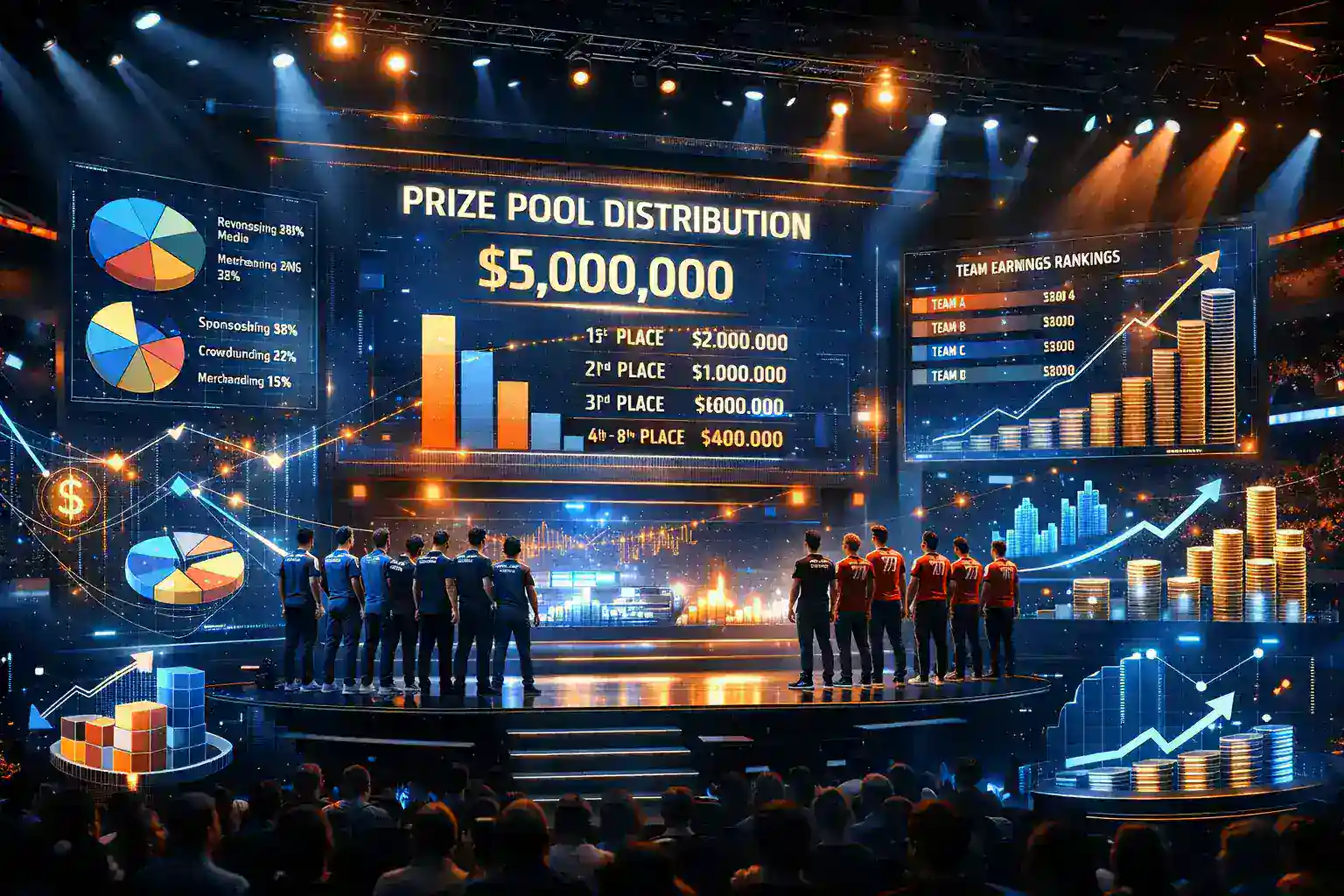
Another defining feature of Esports Prize Pool Economics lies in how tournament organizers distribute financial rewards among participating teams. Distribution models vary widely across esports titles and tournament formats, but they generally follow a structured hierarchy that rewards the highest-performing teams while still providing incentives for mid-tier placements.
Most tournaments allocate a significant portion of the prize pool to the championship team. However, modern distribution models increasingly spread rewards across multiple placements to ensure financial viability for more teams. This approach recognizes the operational costs associated with maintaining professional esports rosters, including coaching staff, analysts, travel logistics, and training facilities.
Balanced prize distribution also supports long-term competitive stability. If financial rewards were limited exclusively to first place, many organizations would struggle to maintain sustainable operations. By expanding reward structures to include multiple placements, Esports Prize Pool Economics contributes to a more resilient professional ecosystem where more teams can remain financially active.
Tournament format design further influences how prize pools operate. Certain competitive structures emphasize seasonal league play with moderate prize payouts distributed across multiple events. Others focus on large championship tournaments where prize pools accumulate into major annual showdowns. These structural choices demonstrate how tournament architecture and Esports Prize Pool Economics interact to shape the rhythm of competitive gaming seasons.
The relationship between tournament formats and prize allocation becomes especially visible when analyzing structured competitive systems. For example, discussions about tournament architecture in esports formats taxonomy reveal how competitive frameworks influence financial incentives throughout the esports calendar.
Prize Pools as Competitive Signals
In economic terms, prize pools function as signaling mechanisms within the esports industry. When tournaments offer substantial financial rewards, they signal prestige, competitive importance, and long-term industry credibility. These signals influence how teams allocate resources, which tournaments they prioritize, and how players plan their professional careers.
For emerging players, tournaments with strong financial incentives often represent career-defining opportunities. A single high-performing result in a major event can dramatically alter a player’s professional trajectory. This dynamic reinforces the broader significance of Esports Prize Pool Economics as a mechanism that links financial opportunity with competitive excellence.
At the organizational level, teams evaluate tournaments not only for competitive prestige but also for financial sustainability. Prize pools therefore influence travel decisions, roster investments, and participation strategies. Organizations must weigh the costs of attending international events against potential prize earnings, making economic analysis an essential part of professional esports management.
As esports continues to mature as a global entertainment industry, the economic frameworks surrounding tournaments will likely become even more sophisticated. The continued evolution of Esports Prize Pool Economics demonstrates how financial structures, competitive incentives, and audience engagement remain deeply interconnected within the expanding world of professional gaming.
Revenue Distribution Inside Professional Esports Teams
While tournament prize pools represent the visible financial reward of competitive gaming, the internal distribution of those rewards within professional teams reveals another important dimension of Esports Prize Pool Economics. Once a team earns prize money from a tournament, the total amount rarely goes directly to the players without structure. Instead, professional organizations typically operate under contractual agreements that define how tournament earnings are shared between players, coaching staff, analysts, and the organization itself.
The internal allocation of prize money often reflects the operational costs required to sustain a competitive esports roster. Teams invest in training facilities, performance analysts, coaching infrastructure, travel logistics, and long-term player development. Because of these investments, organizations may retain a percentage of tournament earnings in order to maintain financial stability. Within the broader framework of Esports Prize Pool Economics, this distribution system ensures that both individual competitors and the organizations supporting them benefit from competitive success.
Players typically receive the largest share of tournament winnings, particularly in team-based esports where the competitive outcome depends directly on player performance. However, modern esports organizations increasingly recognize the value of support staff. Coaches, analysts, and strategic advisors often contribute significantly to competitive preparation, which is why many teams incorporate performance bonuses tied to tournament outcomes. The presence of these structured reward systems highlights how Esports Prize Pool Economics extends beyond tournament organizers and becomes embedded in the internal financial operations of esports organizations.
Prize Pools and the Sustainability of Esports Organizations
From an organizational perspective, tournament prize pools represent both opportunity and risk. High-value competitions can generate substantial financial returns, but reliance on tournament results alone rarely provides a stable economic foundation for professional teams. As a result, modern esports organizations view Esports Prize Pool Economics as one component of a larger financial ecosystem that includes sponsorships, media partnerships, merchandise sales, and digital content creation.
Competitive success certainly improves an organization’s visibility and brand value. Winning major tournaments increases social media reach, attracts sponsorship deals, and enhances fan loyalty. However, prize money itself often fluctuates depending on tournament structures and seasonal performance. For this reason, teams rarely depend solely on tournament earnings as their primary revenue source. Instead, Esports Prize Pool Economics operates alongside other commercial strategies that allow organizations to maintain consistent financial operations even during periods of competitive transition.
Industry reports published by organizations such as Statista frequently highlight how esports revenue streams extend beyond prize pools. These analyses demonstrate that sponsorship agreements and media rights deals often surpass direct tournament winnings in terms of long-term financial stability. Even so, major championship prize pools continue to play an important role in shaping the prestige and competitive relevance of esports tournaments worldwide.
Competitive Incentives and Player Career Development
Professional players experience the impact of Esports Prize Pool Economics most directly through the incentives that prize structures create. Prize pools encourage players to pursue competitive excellence, dedicate time to practice, and invest in skill development. In many esports titles, top-level tournaments represent the primary stage where players can demonstrate their abilities and secure financial rewards that reflect their competitive performance.
The structure of prize pools can also influence how players approach their careers. When tournaments distribute rewards across multiple placements, players are encouraged to maintain consistent performance rather than relying on a single championship victory. This broader distribution model supports long-term professional stability by ensuring that high-performing teams receive financial recognition even when they do not secure first place. Such systems illustrate how Esports Prize Pool Economics contributes to the development of sustainable professional pathways for players entering the competitive gaming scene.
For aspiring competitors progressing through amateur or semi-professional circuits, prize pool structures serve as visible milestones within the esports talent ecosystem. Strong performances in smaller tournaments can provide early financial support while simultaneously attracting attention from professional organizations. This progression reflects the broader developmental systems described in the esports talent pipeline, where emerging players gradually move toward elite competitive environments supported by larger prize pools and global tournaments.
Economic Signals in the Global Esports Industry
Beyond the immediate financial benefits for players and teams, tournament prize pools also act as economic indicators that reflect the overall health of the esports industry. When prize pools increase in size and frequency, they often signal growing commercial investment, expanding audiences, and stronger partnerships between publishers, sponsors, and tournament organizers. Within this context, Esports Prize Pool Economics becomes a measurable indicator of industry momentum.
Large international tournaments frequently generate significant media attention precisely because of their impressive prize pools. These events attract global audiences who view them as defining moments in the competitive gaming calendar. As a result, the scale of tournament rewards often influences media coverage, sponsorship interest, and audience engagement. The visibility generated by major events demonstrates how Esports Prize Pool Economics contributes to shaping public perception of esports as a legitimate and professionally organized competitive industry.
Economic signaling also affects how publishers and tournament organizers plan long-term competitive strategies. Major prize pools can elevate certain tournaments into prestigious annual events, creating recurring traditions within the esports calendar. These landmark competitions establish recognizable stages where the world’s best teams compete for both prestige and financial reward, reinforcing the structural significance of Esports Prize Pool Economics within the global esports ecosystem.
The Interaction Between Data, Performance, and Financial Incentives
Modern esports organizations increasingly rely on performance analytics to maximize their competitive results. Data-driven strategies help teams evaluate player performance, refine tactical decision-making, and optimize in-game coordination. When combined with large tournament prize pools, these analytical approaches demonstrate how competitive performance and financial incentives operate within the same economic framework.
Teams that invest in strategic analysis often gain competitive advantages that translate into improved tournament placements and greater financial returns. This relationship highlights how Esports Prize Pool Economics intersects with analytical systems that evaluate gameplay performance, opponent strategies, and team coordination. Advanced analytical infrastructures enable organizations to approach tournaments with greater precision, transforming competitive preparation into a measurable component of financial success.
These analytical approaches are increasingly common in professional teams that prioritize long-term competitive performance. As explored in esports performance analytics systems, organizations now rely on complex data frameworks to evaluate gameplay patterns and optimize strategic decisions. When tournament rewards are significant, the motivation to invest in performance analytics becomes even stronger, reinforcing the connection between strategic preparation and Esports Prize Pool Economics.
The Future Trajectory of Esports Tournament Economics
The financial structures that define Esports Prize Pool Economics will likely continue evolving as the competitive gaming industry matures. Publishers, tournament organizers, and media platforms are constantly experimenting with new formats, funding models, and revenue-sharing systems designed to balance competitive excitement with long-term financial sustainability. These innovations may include expanded crowdfunding initiatives, improved revenue sharing with teams, or new digital engagement systems that allow audiences to participate more directly in tournament ecosystems.
At the same time, the growth of global esports audiences continues to attract new sponsors, investors, and media partners. As competitive gaming becomes more integrated into mainstream entertainment culture, prize pools may increasingly reflect the scale of global interest surrounding esports events. Within this environment, Esports Prize Pool Economics will remain a central component of tournament identity, shaping the prestige, competitiveness, and financial structure of major international competitions.
Conclusion
Prize pools represent far more than symbolic rewards at the end of a tournament bracket. They function as strategic economic mechanisms that influence how tournaments are organized, how teams operate, and how players pursue professional careers in competitive gaming. Through complex funding systems, structured distribution models, and powerful competitive incentives, Esports Prize Pool Economics has become one of the defining elements of the global esports industry.
As esports continues expanding into a sophisticated entertainment ecosystem, the economic architecture surrounding tournaments will remain a key factor in shaping the industry’s long-term trajectory. Whether through publisher investment, community participation, sponsorship partnerships, or innovative digital funding models, the evolution of Esports Prize Pool Economics reflects the growing maturity of competitive gaming as a global professional sport.