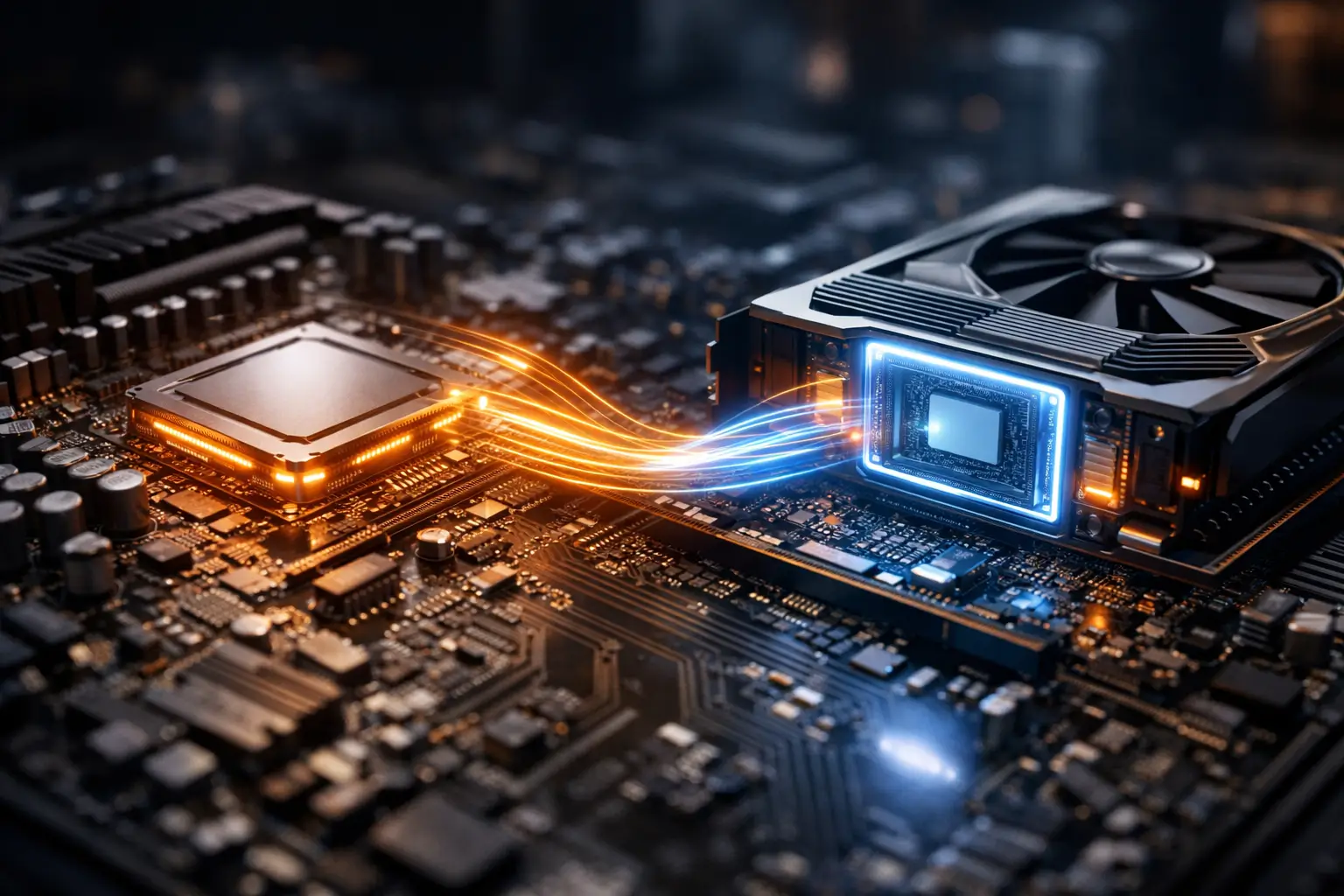
Draw Call Overhead: The Hidden Performance Killer Destroying Smooth Gaming
Modern PC gaming performance is often associated with GPU power, memory bandwidth, or CPU frequency, but one of the most important low-level limitations rarely discussed outside technical circles is Draw Call Overhead. This hardware–software interaction defines how efficiently the CPU communicates with the GPU, and in many modern games it becomes the real performance boundary long before the graphics card reaches its full potential.
Understanding Draw Call Overhead is essential for analyzing real gaming performance, especially in modern engines that render complex worlds, thousands of objects, and high-detail environments in real time. Even high-end gaming PCs can suffer from inconsistent frame pacing, unexpected CPU bottlenecks, and unstable GPU usage when the number of draw calls exceeds what the system can process efficiently.
Unlike thermal limits or memory bandwidth restrictions, Draw Call Overhead exists at the intersection of CPU architecture, graphics APIs, driver design, and GPU execution pipelines. Because of this, it cannot be solved by simply upgrading a graphics card, and its impact becomes more visible as game engines grow more complex.
Understanding the Role of Draw Calls in Modern Rendering
A draw call is a command sent from the CPU to the GPU instructing it to render a specific object using a defined set of shaders, textures, and buffers. Every visible object in a scene may require one or more draw calls depending on how the engine organizes rendering tasks. Characters, shadows, reflections, particles, terrain, and user interface elements all contribute to the total number of draw calls processed each frame.
In early 3D games, the number of objects on screen was limited, so draw call overhead rarely became a problem. However, modern engines render highly detailed scenes with thousands of individual meshes and materials, dramatically increasing the workload on the CPU side of the rendering pipeline.
Each draw call requires validation, state changes, memory references, and synchronization between CPU and GPU. This process introduces overhead that can accumulate quickly, especially in scenes with many small objects rather than a few large ones.
This is why two games running at the same resolution with the same GPU can show very different performance behavior. The difference often comes from how many draw calls the engine generates and how efficiently the system can handle them.
Why Draw Call Overhead Becomes a CPU Bottleneck
The GPU cannot start rendering until the CPU prepares the commands. When the number of draw calls increases, the CPU must spend more time building command buffers, validating resources, and communicating with the graphics driver. This creates a bottleneck that limits overall frame rate even when GPU usage appears low.
This type of limitation is often confused with general CPU weakness, but the real issue is not raw processing power alone. Instead, the overhead comes from the communication layer between CPU, driver, and graphics API.
In some situations, increasing CPU frequency improves performance, but the improvement may be smaller than expected because the bottleneck is caused by draw call management rather than pure computation speed.
This behavior is closely related to frame pacing stability. When the CPU cannot prepare draw calls consistently, frame times become uneven, which leads to micro-stutter even when the average frame rate looks acceptable. A deeper explanation of frame pacing behavior can be found in this analysis of frame stability:
Frame Time Consistency: The Invisible Factor Behind Truly Smooth Gaming.
Driver Validation and API Overhead
One of the biggest contributors to Draw Call Overhead is driver validation. Before the GPU executes any command, the graphics driver must verify that resources are valid, memory addresses are correct, and states are compatible. This process ensures stability but adds extra CPU work for every draw call.
Older graphics APIs such as DirectX 11 rely heavily on driver validation, which increases overhead when draw call counts become high. Modern APIs like DirectX 12 and Vulkan reduce this cost by giving more control to the game engine, allowing developers to manage command buffers more directly.
However, reducing driver overhead does not remove the problem entirely. It simply shifts responsibility to the engine, meaning poorly optimized games can still suffer from high Draw Call Overhead even on modern APIs.
Detailed technical documentation about graphics API command submission can be found in official developer resources such as
Microsoft DirectX 12 documentation,
which explains how command lists and queues are handled at the hardware level.
Single-Thread Performance and Command Submission Limits
Many parts of the rendering pipeline still depend on single-thread performance, especially when preparing draw calls. Even though modern CPUs have many cores, command submission often runs on a limited number of threads, which means high clock speed and strong per-core performance remain important for gaming.
When the CPU cannot prepare commands fast enough, the GPU waits idle. This results in low GPU usage even though the graphics card is capable of rendering more frames. Players sometimes interpret this as poor GPU optimization, but the real cause is Draw Call Overhead on the CPU side.
Cache performance also plays an important role in this process. Efficient cache usage allows the CPU to prepare commands faster and reduces latency during state changes. A deeper look at cache behavior in gaming workloads can be found here:
CPU Cache Performance: The Hidden Force Shaping Frame Stability and Gaming Smoothness.
Scene Complexity and Object Count
Draw Call Overhead increases with scene complexity. Open-world games, simulation titles, and modern RPGs often contain thousands of objects visible at once. Each object may require multiple draw calls depending on materials, lighting passes, and post-processing effects.
Engines try to reduce overhead using techniques such as batching, instancing, and level-of-detail systems, but these methods have limits. When scenes become extremely detailed, the number of draw calls can exceed what the CPU can handle in real time.
This is one reason why performance differences between game engines can be large even on identical hardware. The engine that manages draw calls more efficiently will often deliver smoother gameplay, lower CPU usage, and more stable frame times.
Relationship Between Draw Calls and PCIe Communication
Although draw calls are mostly handled inside system memory and CPU cache, communication with the GPU still depends on the PCIe interface. When command buffers and resources are transferred to the graphics card, latency and bandwidth can influence how quickly the GPU receives instructions.
Modern PCIe standards provide enough bandwidth for most gaming workloads, but inefficient command submission combined with high draw call counts can increase synchronization delays. This interaction between CPU, GPU, and PCIe link is explained in more detail in this hardware analysis:
PCIe Bandwidth Scaling Bottleneck: The Critical Hardware Limit That Can Seriously Reduce Gaming Performance.
Why Modern Games Are More Sensitive to Draw Call Overhead
Game engines today aim for cinematic detail, large environments, and advanced lighting systems. Techniques such as physically based rendering, dynamic shadows, and real-time reflections increase the number of rendering passes required for each frame. Each pass can generate additional draw calls, multiplying the workload on the CPU.
At the same time, players expect higher frame rates, especially on high refresh rate monitors. Rendering at 144 Hz or higher means the system must complete all draw call processing in a much shorter time, making overhead more visible than in older games that targeted 30 or 60 frames per second.
Because of this, Draw Call Overhead has become one of the most important hidden limits in modern gaming hardware performance, even though it is rarely mentioned in official system requirements.
Modern Rendering Pipelines and the Growth of Draw Call Overhead
As game engines evolved toward physically based rendering, dynamic lighting, and real-time global illumination, the internal rendering pipeline became significantly more complex. This complexity directly increases Draw Call Overhead because each rendering pass may require additional commands, state changes, and synchronization points between CPU and GPU.
In older rendering models, a frame could be completed using a relatively small number of draw calls. Modern engines, however, may execute thousands of commands per frame due to multiple lighting passes, shadow maps, reflections, post-processing effects, and layered materials. Every additional pass multiplies the number of commands the CPU must prepare before the GPU can begin execution.
This is one of the reasons modern games sometimes show lower performance on powerful hardware compared to older titles. The limitation is not always GPU strength, but the increasing cost of command submission and validation inside the rendering pipeline.
DirectX 12, Vulkan, and Low-Level Graphics APIs
Low-level graphics APIs were introduced to reduce the cost associated with Draw Call Overhead. DirectX 12 and Vulkan allow developers to control command buffers directly, reducing the amount of work performed by the driver and giving the engine more responsibility for resource management.
In theory, this approach allows games to handle a much larger number of draw calls per frame. In practice, the benefit depends heavily on engine design and developer optimization. When command buffers are not organized efficiently, the CPU can still become the limiting factor even with modern APIs.
Official technical documentation describing command lists, queues, and GPU execution models can be found in developer resources such as
AMD GPUOpen,
which explains how modern engines interact with hardware at a low level.
Because these APIs reduce driver validation, they expose performance problems that were previously hidden. If an engine generates too many commands, the overhead becomes visible immediately, especially in scenes with many small objects or complex material systems.
Batching, Instancing, and Command List Optimization
To control Draw Call Overhead, game engines use several optimization techniques. Batching combines multiple objects into a single draw call when they share the same material and shader. Instancing allows the GPU to render many copies of the same object using one command, which reduces CPU workload significantly.
Command list optimization is another important technique. Instead of sending commands one by one, the engine prepares large batches of instructions that the GPU can execute without interruption. This reduces synchronization cost and improves CPU efficiency.
However, these optimizations are not always possible. Scenes with many unique materials, dynamic objects, or procedural geometry often require separate draw calls. When this happens, Draw Call Overhead grows quickly and becomes one of the main limits on performance.
This behavior explains why some open-world games show high CPU usage even when the GPU is not fully loaded. The CPU is busy managing command submission rather than performing heavy calculations.
GPU Utilization and Hidden CPU Limits
One of the most confusing situations for PC gamers occurs when GPU usage stays below 80% while frame rate remains low. In many cases, this is caused by Draw Call Overhead. The GPU is waiting for the CPU to send commands, so it cannot reach full utilization.
Monitoring tools often show this as a CPU bottleneck, but the real cause is the communication layer between CPU, driver, and graphics API. This type of limit becomes more common at lower resolutions where the GPU finishes rendering quickly and waits for new commands.
Increasing graphics settings sometimes improves GPU usage because each frame takes longer to render, giving the CPU more time to prepare commands. This counterintuitive behavior is a classic sign that Draw Call Overhead is the real performance limit.
Similar behavior can also be observed when frame pacing becomes inconsistent. Uneven command submission leads to irregular frame times, which produces micro-stutter even when average FPS appears stable.
Open-World Games and Object Density
Large open-world environments represent one of the worst cases for Draw Call Overhead. Cities, forests, crowds, and complex interiors can contain thousands of visible objects at the same time. Even with aggressive level-of-detail systems, the number of draw calls required to render these scenes can be extremely high.
Modern engines try to stream objects dynamically, but every object still needs to be prepared by the CPU before the GPU can render it. When the number of commands grows beyond what the CPU can handle in one frame, performance drops even if the graphics card is powerful enough to render the scene.
This is why CPU upgrades often improve performance in simulation games, strategy titles, and large RPGs more than GPU upgrades. These genres generate many draw calls due to high object counts and complex scene management.
Driver Design and Platform Differences
Graphics driver design also affects Draw Call Overhead. Different GPU vendors use different validation methods, memory management strategies, and scheduling systems. As a result, the same game may show different CPU usage on different hardware even when the GPU performance is similar.
Operating system scheduling can also influence command submission latency. Background processes, thread priorities, and driver overhead all contribute to the final cost of each draw call.
Because of these factors, performance analysis must consider the entire system rather than focusing only on GPU speed. CPU architecture, cache size, memory latency, and driver efficiency all play a role in determining how many draw calls can be processed per frame.
High Refresh Rate Gaming and Command Processing Limits
High refresh rate monitors make Draw Call Overhead more visible. Rendering at 144 Hz requires the system to complete all command preparation in less than seven milliseconds. At 240 Hz, the available time is even smaller.
When the CPU cannot prepare draw calls fast enough, frame rate becomes unstable even if the GPU is capable of much higher performance. This is why competitive gaming systems often benefit from high clock speeds and strong single-thread performance rather than just powerful graphics cards.
Reducing overhead in the command submission stage allows the GPU to stay fully utilized, resulting in smoother frame pacing and more consistent input response.
Future Engine Design and Reducing Draw Call Overhead
New engine technologies are designed to reduce Draw Call Overhead by moving more work to the GPU. Techniques such as mesh shaders, GPU-driven rendering, and bindless resources allow the graphics card to handle tasks that previously required CPU intervention.
These approaches reduce the number of commands sent per frame and allow modern hardware to render more complex scenes without increasing CPU load. However, they require advanced engine design and are not yet used in every game.
As rendering technology continues to evolve, the importance of efficient command submission will remain critical. Even the most powerful GPU cannot deliver smooth performance if the CPU cannot feed it with commands fast enough.
Conclusion
Draw Call Overhead is one of the most important hidden limits in modern gaming performance. It represents the cost of communication between CPU and GPU, and it can restrict frame rate, reduce GPU utilization, and cause unstable frame pacing even on high-end systems.
Unlike thermal throttling or memory bandwidth limits, this bottleneck exists at the software–hardware boundary, making it harder to detect and more difficult to solve. Engine design, graphics APIs, driver efficiency, CPU architecture, and scene complexity all influence how much overhead is generated during rendering.
As games become more detailed and rendering pipelines grow more advanced, the number of draw calls per frame continues to increase. Understanding how Draw Call Overhead works helps explain why some games require strong CPUs, why performance can vary between engines, and why smooth gameplay depends on more than just raw GPU power.
For modern gaming hardware, efficient command processing is just as important as graphics performance itself. Systems that minimize Draw Call Overhead can maintain stable frame times, higher GPU usage, and consistent responsiveness, which ultimately defines the real quality of the gaming experience.