

The Esports Talent Pipeline: Systems, Scouting Networks, and the Rise of Future Professional Players
Competitive gaming has evolved into a structured global industry with professional teams, dedicated coaching staff, advanced analytics departments, and large international tournaments. At the heart of this ecosystem lies a powerful but often overlooked system known as the esports talent pipeline. This framework enables organizations to discover, evaluate, and develop the next generation of elite competitors long before they appear on major tournament stages.
Unlike early competitive gaming scenes where players simply emerged from online communities, modern organizations rely on a carefully constructed esports talent pipeline that mirrors development systems used in traditional sports. Professional teams monitor ranked ladders, analyze performance data, scout amateur tournaments, and cultivate academy teams that prepare promising players for professional competition.
As the competitive gaming industry continues to expand, the esports talent pipeline has become one of the most important foundations sustaining long-term growth. Organizations that build strong scouting networks and structured training systems gain a consistent advantage by continuously introducing new talent into their competitive rosters.
The Structural Foundations of the Esports Talent Pipeline
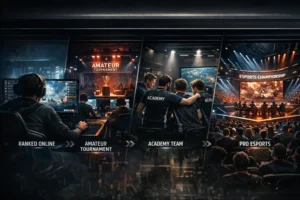
The modern esports talent pipeline is built upon several interconnected layers. These layers form a progression path that allows players to move from casual competitive environments into highly professional systems where skills are refined through coaching, data analysis, and intensive practice routines.
At the base of this structure lies the global player population participating in ranked matchmaking systems. Millions of players compete daily in online ladders, generating enormous amounts of performance data. This massive competitive environment forms the entry point of the esports talent pipeline, where the first indicators of elite mechanical skill and strategic awareness begin to emerge.
From this large base, talented individuals begin appearing in amateur tournaments and semi-professional competitions. These events are often monitored by scouts, analysts, and coaching staff working within esports organizations. Their goal is not simply to identify high-ranking players but to evaluate deeper qualities such as decision-making consistency, adaptability, teamwork, and psychological resilience.
Professional organizations frequently build dedicated scouting frameworks that monitor these competitive environments. These frameworks connect directly to the larger competitive infrastructure discussed in our previous analysis of the
professional esports ecosystem, where teams, infrastructure, and industry stakeholders operate together to sustain competitive gaming as a global industry.
Digital Scouting and Competitive Data Analysis

One of the defining characteristics of the modern esports talent pipeline is its reliance on large-scale performance data. Every ranked match, tournament game, and scrimmage generates valuable information about player performance. This data allows analysts to evaluate competitors far beyond simple win rates or leaderboard rankings.
Advanced analytical tools examine metrics such as reaction times, decision efficiency, positioning patterns, objective control, and team coordination behaviors. These metrics help organizations identify players whose skill sets demonstrate long-term competitive potential. The ability to analyze such granular data has dramatically improved the accuracy of scouting within the esports talent pipeline.
Some organizations maintain internal databases that track hundreds of promising players across multiple competitive tiers. Analysts continuously monitor these players over extended periods to determine whether their performance remains stable under different competitive conditions. This long-term evaluation process helps teams avoid short-term hype and focus on sustainable talent development.
Industry research platforms such as
Esports Charts
also provide valuable insight into competitive trends, tournament structures, and audience engagement metrics that help organizations understand the broader competitive landscape surrounding the esports talent pipeline.
Amateur Tournaments as Competitive Testing Grounds
Amateur tournaments represent a critical stage within the esports talent pipeline. While ranked ladders reveal mechanical skill, organized competitions demonstrate how players perform within structured team environments and high-pressure situations.
These tournaments often function as unofficial proving grounds where rising competitors gain visibility among scouts and team managers. Players who perform consistently in amateur leagues begin attracting attention from organizations searching for future roster candidates.
Many of today’s professional stars first appeared in small regional competitions before gradually advancing through increasingly competitive leagues. The ability to perform in structured tournament environments demonstrates that a player possesses not only mechanical ability but also communication skills, strategic awareness, and mental discipline.
The esports talent pipeline therefore relies heavily on these competitive layers to separate promising individuals from players whose success exists only within casual matchmaking environments.
Academy Teams and Structured Player Development
Once promising players are identified, organizations frequently integrate them into academy programs. These programs represent a formalized stage within the esports talent pipeline, where players transition from independent competitors into structured team environments guided by professional coaching staff.
Academy teams serve several strategic purposes. They allow organizations to test potential recruits without immediately committing them to primary competitive rosters. At the same time, they provide young players with access to professional training infrastructure, strategic guidance, and analytical feedback systems.
Training within academy environments often mirrors the routines followed by professional teams. Players participate in scheduled scrimmages, review recorded gameplay sessions, and receive individual performance analysis from coaching staff. Over time, these systems refine decision-making speed, teamwork coordination, and strategic understanding.
This stage of the esports talent pipeline plays a crucial role in transforming raw mechanical ability into professional-level competitive discipline.
The Role of Coaches and Performance Analysts
Behind every successful competitive roster lies a network of specialists working to maximize player performance. Coaches, analysts, and performance managers all contribute to the long-term effectiveness of the esports talent pipeline.
Coaches focus on strategy development, communication structures, and team coordination. Analysts study gameplay data to identify patterns that can be refined or corrected. Performance managers often assist players with schedule management, mental preparation, and long-term skill development.
Together, these professionals transform the esports talent pipeline from a simple scouting process into a complete developmental framework that continuously produces competitive players capable of performing at the highest levels of the industry.
Streaming Platforms and Visibility in the Esports Talent Pipeline
While competitive tournaments remain a central component of professional scouting, modern streaming platforms have also become an influential element of the esports talent pipeline. Broadcasting gameplay allows players to demonstrate their skills, personality, and communication style to both audiences and potential recruiters.
Platforms such as
Twitch
have enabled countless players to build visibility within competitive communities. A player who consistently displays strong mechanics, strategic understanding, and positive teamwork behavior during live streams may attract attention from scouts searching for emerging talent.
Streaming also provides organizations with an opportunity to evaluate a player’s communication habits and personality traits. Professional competition requires more than mechanical skill; teamwork, discipline, and adaptability all play critical roles in determining long-term success within the esports talent pipeline.
From Ranked Competitor to Professional Player
The progression through the esports talent pipeline rarely occurs overnight. Instead, most players advance through multiple competitive layers before reaching professional leagues. This gradual progression allows organizations to observe how players respond to increasing levels of strategic complexity and competitive pressure.
Initially, players distinguish themselves within ranked environments by demonstrating exceptional mechanical consistency and game awareness. Their next step typically involves participation in amateur tournaments where teamwork and communication become essential factors.
Successful competitors may then join semi-professional teams or academy rosters. Within these structured environments, players receive coaching support and strategic training that significantly accelerates skill development. Over time, standout performers within these developmental systems earn opportunities to compete within major professional leagues.
Each stage within the esports talent pipeline acts as a filter that refines talent while eliminating players who struggle to adapt to increasingly competitive environments.
Psychological Resilience in Competitive Gaming
One of the most underestimated aspects of the esports talent pipeline involves psychological resilience. Competitive gaming at the highest level requires players to perform under intense pressure while maintaining consistent decision-making speed.
Professional matches are frequently broadcast to global audiences, and performance mistakes can quickly attract public scrutiny. Players who succeed within the esports talent pipeline must therefore develop strong mental discipline, emotional stability, and the ability to recover quickly from setbacks.
Some organizations now collaborate with performance psychologists to help players manage stress and maintain focus during tournaments. These psychological training programs further demonstrate how the esports talent pipeline has evolved into a comprehensive development system comparable to those used in traditional sports.
Regional Talent Development Systems
Different regions have developed unique approaches to structuring their esports talent pipeline. In some areas, university leagues and collegiate competitions provide an early stage where players gain organized competitive experience. In others, community tournaments and grassroots leagues play a more significant role.
Regardless of the specific structure, the underlying objective remains consistent: identify promising players, provide them with structured training opportunities, and gradually integrate them into professional competition.
Organizations that successfully maintain strong regional scouting networks often gain a strategic advantage. By continuously monitoring local competitions and online leaderboards, they ensure that the esports talent pipeline remains filled with emerging competitors capable of strengthening future rosters.
The Long-Term Importance of Talent Development
Sustainable success within competitive gaming depends heavily on the strength of an organization’s esports talent pipeline. Teams that rely exclusively on established stars often struggle to maintain long-term competitive dominance as player performance naturally fluctuates over time.
By contrast, organizations that invest in structured scouting systems and academy programs create a constant flow of new competitors entering their training environments. This approach ensures that teams remain adaptable as the competitive landscape evolves.
The broader esports industry also benefits from these systems. As the esports talent pipeline expands, more players gain opportunities to pursue competitive careers while audiences gain access to fresh personalities and evolving competitive narratives.
The Future Evolution of the Esports Talent Pipeline
The structure of the esports talent pipeline will likely continue evolving alongside advances in data analytics, coaching technology, and global connectivity. Artificial intelligence tools may eventually assist analysts in identifying subtle gameplay patterns that indicate long-term competitive potential.
At the same time, improved training infrastructure, performance tracking systems, and international amateur leagues may further strengthen the pathways connecting aspiring competitors to professional teams.
What remains certain is that competitive gaming will continue relying on the esports talent pipeline as a core mechanism for sustaining professional competition. As long as new players continue entering ranked ladders, streaming platforms, and amateur tournaments, the next generation of elite competitors will always be waiting somewhere within this vast global network.
Conclusion
The rise of esports as a global competitive industry has transformed talent discovery into a sophisticated process supported by scouting networks, performance analytics, academy teams, and structured training systems. Together these elements form the modern esports talent pipeline, a framework that continuously identifies and develops the players who will shape the future of competitive gaming.
For organizations, investing in strong development systems ensures long-term competitiveness. For aspiring players, the esports talent pipeline represents a clear pathway from online competition to professional stages. As the industry continues expanding, this pipeline will remain one of the most essential foundations supporting the growth and sustainability of esports worldwide.
To read a similar article, take a look : Inside the Professional Esports Ecosystem: Infrastructure, Organizations, and the Competitive Gaming Industry