The Hidden Intelligence of Competitive Gaming: Esports Performance Analytics Systems Powering Modern Teams
Modern esports has evolved far beyond raw mechanical skill and quick reflexes. While the public image of competitive gaming often focuses on elite players performing under intense pressure, another layer of the industry operates quietly behind the scenes. This hidden layer is built on data, analysis, and strategic intelligence. At the center of this transformation are Esports Performance Analytics systems, which have become essential tools for professional teams competing at the highest level.
Just as traditional sports rely heavily on statistics, video analysis, and performance metrics, competitive gaming organizations now depend on complex analytical frameworks to evaluate player performance, understand opponent strategies, and refine tactical decision-making. These systems transform raw gameplay data into actionable insights that shape everything from training routines to in-game strategy adjustments.
The rapid growth of esports as a global entertainment industry has accelerated the adoption of Esports Performance Analytics across major teams and tournaments. Organizations increasingly invest in analysts, data engineers, and software tools capable of breaking down massive amounts of gameplay information. In a competitive environment where milliseconds and micro-decisions can determine victory or defeat, data-driven preparation has become a decisive advantage.
The Evolution of Data-Driven Competition in Esports
The early years of competitive gaming relied mostly on instinct and experience. Teams studied replays manually, discussed strategy informally, and improved through repetition. As esports matured into a structured professional ecosystem, the need for deeper analysis grew significantly. Organizations began to treat gameplay data as a valuable competitive resource rather than simple post-match footage.
Today, Esports Performance Analytics represents a sophisticated discipline that merges gameplay observation with advanced statistical interpretation. Instead of merely reviewing matches, analysts can extract detailed insights from thousands of in-game events such as player positioning, movement patterns, resource management, and tactical execution during key moments.
This shift toward analytical competition parallels the development of the broader professional ecosystem discussed in
Inside the Professional Esports Ecosystem: Infrastructure, Organizations, and the Competitive Gaming Industry.
As esports organizations expanded their operational structures, analytics departments naturally emerged as an essential component of modern competitive teams.
The result is a strategic environment where performance improvement is no longer based solely on intuition. Instead, Esports Performance Analytics enables teams to identify measurable trends, evaluate strengths and weaknesses objectively, and design training systems tailored to the specific demands of each competitive title.
What Esports Performance Analytics Actually Measures
At its core, Esports Performance Analytics revolves around collecting and interpreting data generated during gameplay. Every match produces an enormous amount of information that can be analyzed from multiple angles. These data points allow analysts to build a comprehensive picture of player behavior, team coordination, and strategic decision-making across different competitive scenarios.
Some of the most common analytical categories include player efficiency metrics, positional heatmaps, reaction timings, and tactical engagement patterns. These measurements help teams evaluate how effectively players perform within the team structure and how consistently they execute strategic plans under pressure.
Performance metrics are particularly valuable when analyzing consistency over long tournament cycles. A single match may not reveal meaningful trends, but when hundreds of rounds or matches are analyzed collectively, patterns begin to emerge. These patterns allow analysts to detect subtle strengths and weaknesses that might otherwise remain invisible during normal gameplay observation.
Because of this analytical depth, Esports Performance Analytics has become one of the most influential tools for coaching staffs and team strategists. Coaches increasingly rely on data dashboards and visual analytics tools to review matches with players, helping them understand not only what happened during a match, but why specific outcomes occurred.
The Role of Analysts Inside Professional Teams
Behind every modern esports roster there is often a specialized analyst responsible for translating gameplay data into strategic insights. These analysts work closely with coaches and players to interpret complex data sets and identify opportunities for improvement. Their responsibilities range from opponent scouting to internal performance evaluation.
In many organizations, analysts build detailed reports before major tournaments. These reports rely heavily on Esports Performance Analytics systems to examine opponent tendencies, map strategies, and historical performance data. By studying how rival teams behave in specific situations, analysts can help their team prepare targeted counter-strategies.
The analytical role is also crucial for player development. Competitive players constantly seek marginal improvements, and data analysis provides objective feedback that traditional practice cannot always reveal. For example, analysts might discover recurring positioning mistakes, inefficient resource usage, or delayed reaction patterns that can be corrected through focused training sessions.
This analytical feedback loop complements the player development structures described in
The Esports Talent Pipeline: Systems, Scouting Networks, and the Rise of Future Professional Players.
Young competitors entering professional teams often adapt faster when their performance is supported by structured data analysis rather than simple trial-and-error practice.
Strategic Intelligence and Match Preparation
Match preparation has become one of the most sophisticated applications of Esports Performance Analytics. Before major tournaments, teams analyze vast libraries of opponent matches to identify strategic patterns. These patterns may include preferred map selections, common tactical openings, or recurring defensive structures used by rival teams.
Instead of approaching matches blindly, teams now enter competitions with a comprehensive understanding of their opponents’ tendencies. Analytical reports often highlight predictable behaviors that can be exploited during gameplay. For instance, analysts might notice that a rival team frequently commits resources to a particular map area during early rounds, allowing coaches to design counter-strategies that disrupt that pattern.
Professional esports has therefore become a contest not only of mechanical skill but also of strategic preparation. Esports Performance Analytics provides the information layer that allows teams to anticipate scenarios before they occur inside the game environment.
The Growing Importance of Data Visualization
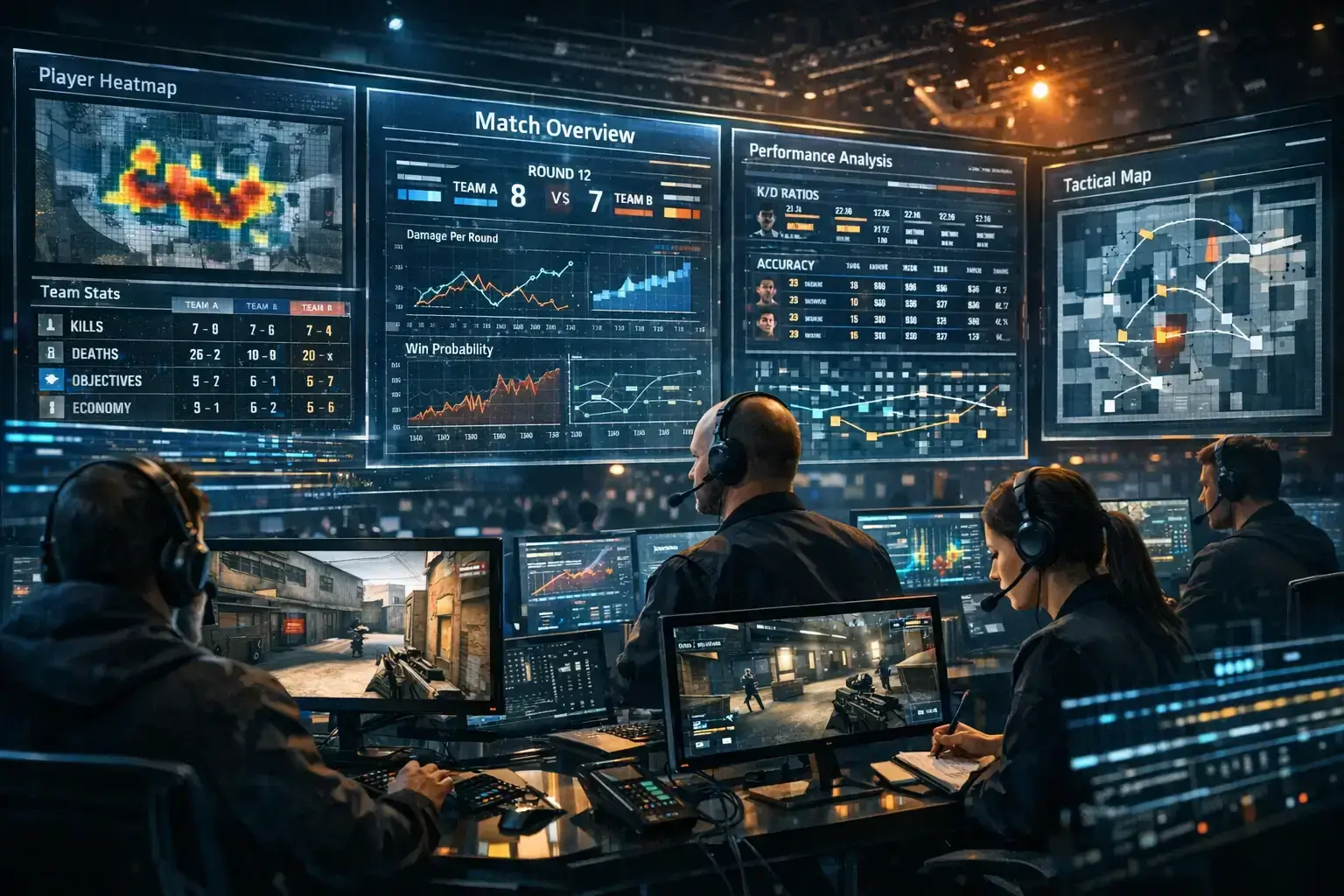
One of the most fascinating aspects of modern Esports Performance Analytics is the way complex data is transformed into visual tools that players and coaches can easily interpret. Raw numbers alone are rarely useful during competitive preparation. Instead, analysts convert statistical data into visual dashboards, charts, and heatmaps that reveal gameplay patterns in an intuitive format.
Heatmaps, for example, illustrate how players move across a map during matches. By analyzing these visualizations, coaches can quickly detect positional habits that may be predictable to opponents. Similarly, timeline graphs can show how momentum shifts during a match, highlighting critical turning points where strategic decisions altered the outcome.
These visualization tools make Esports Performance Analytics far more accessible to players who may not have a background in statistical analysis. Instead of studying spreadsheets filled with raw numbers, players can immediately recognize trends through visual cues and adapt their gameplay accordingly.
The integration of visual analytics into esports strategy reflects the broader professionalization of competitive gaming. As the industry continues to mature, the ability to transform data into meaningful insights will likely remain one of the defining competitive advantages for elite teams.
Specialized Tools Behind Esports Performance Analytics
The rapid development of professional esports has encouraged the creation of specialized analytical tools designed specifically for competitive gaming environments. These tools collect, organize, and interpret massive volumes of gameplay data generated during matches and scrimmages. Without these systems, the scale of modern Esports Performance Analytics would be nearly impossible to manage efficiently.
Professional teams often rely on custom dashboards that aggregate statistics from multiple matches and tournaments. These dashboards allow analysts to review detailed information about player decision-making, map control, reaction timing, and tactical coordination. Instead of manually tracking every in-game event, analysts can quickly explore datasets that reveal patterns across hundreds of rounds.
Many of these analytical platforms integrate replay analysis, statistical modeling, and visual dashboards into a single environment. By combining these elements, Esports Performance Analytics becomes far more than a simple statistical record. It becomes an operational tool that supports training, strategy planning, and competitive preparation.
Public esports data platforms also contribute to the growth of analytical culture within the industry. Websites such as Esports Charts provide viewership and tournament statistics that help analysts and researchers understand how competitive gaming continues to evolve globally. Although these resources primarily focus on audience metrics, they demonstrate how deeply data analysis is embedded in the esports ecosystem.
Opponent Scouting and Tactical Intelligence
One of the most strategic applications of Esports Performance Analytics lies in opponent scouting. Before major tournaments, analysts spend hours reviewing match histories to identify predictable tactical patterns used by rival teams. These scouting processes are extremely detailed and often focus on specific scenarios that frequently appear during competition.
For example, analysts may examine how a rival team handles early-game positioning, how frequently certain strategies appear on specific maps, or how players behave during high-pressure rounds. These insights allow coaches to prepare targeted counter-strategies before the match even begins. In many cases, preparation based on Esports Performance Analytics can neutralize an opponent’s most reliable tactics.
Opponent scouting also allows teams to anticipate potential adjustments. If analysts notice that a rival team consistently adapts their strategy after losing certain rounds, coaches can prepare secondary tactics designed to respond to those adjustments. The result is a strategic chess match where preparation extends far beyond what spectators see during the live broadcast.
These scouting practices have become an essential part of tournament preparation, particularly in structured leagues and championship events. The competitive structures explored in
Mapping the Esports Formats Taxonomy: Competitive Structures, Tournament Models, and the Architecture of Modern Esports
create environments where long-term preparation and analytical research play a critical role in determining success.
Improving Player Development Through Data
Beyond strategic preparation, Esports Performance Analytics plays a major role in long-term player development. Professional players constantly search for small improvements that can elevate their performance over time. Analytical systems help identify these opportunities by revealing patterns that may not be visible during normal gameplay review.
For instance, analysts might observe that a player consistently reacts slightly slower during certain defensive situations. While the difference might only be a fraction of a second, such delays can significantly affect outcomes during high-level competition. Through Esports Performance Analytics, coaches can isolate these moments and design targeted practice scenarios to strengthen the player’s response.
Similarly, teams may analyze how effectively players coordinate during complex team engagements. Data might reveal whether players tend to overcommit resources, rotate too late across the map, or fail to maintain optimal spacing during tactical maneuvers. By identifying these subtle weaknesses, analytical systems help transform individual practice into structured performance improvement.
In many organizations, player review sessions now involve both video playback and analytical dashboards. Coaches present data-driven insights while reviewing gameplay footage, allowing players to understand the reasoning behind strategic feedback. This structured approach demonstrates how deeply Esports Performance Analytics has been integrated into modern training environments.
The Expanding Role of Artificial Intelligence
As the esports industry continues to evolve, artificial intelligence is beginning to play an increasingly important role in analytical systems. Advanced machine learning models can process vast datasets far faster than human analysts, identifying gameplay patterns that might otherwise remain hidden. This technological evolution is gradually expanding the capabilities of Esports Performance Analytics.
AI-assisted tools can evaluate player positioning, tactical decision-making, and mechanical efficiency across thousands of matches. Instead of analyzing individual rounds manually, algorithms can detect recurring patterns in player behavior and generate predictive insights about potential strategies. These capabilities are particularly valuable for organizations managing multiple teams or competing across several titles simultaneously.
Despite these technological advancements, human interpretation remains crucial. Analysts still play a central role in translating algorithmic insights into practical strategies that players can apply during competition. In other words, artificial intelligence enhances Esports Performance Analytics, but it does not replace the expertise of experienced analysts and coaches.
This collaboration between human expertise and analytical technology represents one of the most fascinating developments within competitive gaming. As analytical systems become more sophisticated, the strategic dimension of esports will likely continue expanding alongside mechanical skill and teamwork.
Broadcast Analysis and the Viewer Experience
The influence of Esports Performance Analytics is no longer limited to teams and coaches. Broadcast productions increasingly incorporate analytical insights into tournament coverage, allowing audiences to better understand the strategic depth of professional matches. Viewers can now see statistical comparisons, player performance metrics, and tactical visualizations displayed during live broadcasts.
These analytical segments help transform esports broadcasts into more informative experiences for spectators. Instead of simply watching gameplay unfold, audiences gain insight into why certain decisions matter and how strategic adjustments influence the outcome of matches. This educational layer has helped esports commentary evolve into a more analytical form of storytelling.
Websites such as Liquipedia also contribute to this analytical culture by documenting match results, roster histories, and tournament statistics across many competitive titles. These resources allow fans, analysts, and journalists to explore the historical data that shapes modern esports narratives.
Through these platforms and broadcast tools, Esports Performance Analytics extends beyond the competitive arena and becomes part of the wider esports media ecosystem.
The Strategic Future of Competitive Gaming
Looking forward, the importance of Esports Performance Analytics will likely continue growing as the industry becomes more sophisticated. Teams are already investing heavily in data infrastructure, analytical personnel, and specialized software designed to refine competitive strategy. These investments reflect the recognition that data-driven preparation can provide decisive advantages in elite competition.
Future developments may include real-time analytics during live matches, deeper AI-assisted strategy modeling, and improved visualization systems that allow players to interact with gameplay data more intuitively. As analytical tools become more advanced, teams will gain even greater insight into the complex tactical ecosystems that define modern esports.
At the same time, the human element of competition will remain essential. No analytical system can fully replicate the creativity, intuition, and adaptability displayed by elite players during high-pressure moments. Instead, Esports Performance Analytics serves as a strategic support system that empowers players to perform at their highest potential.
Competitive gaming has already transformed from a hobbyist activity into a global professional industry supported by organizations, leagues, and advanced technological infrastructure. Within this evolving environment, analytics has emerged as one of the most powerful forces shaping how teams prepare, compete, and improve.
As esports continues expanding worldwide, the hidden intelligence behind the scenes will remain just as important as the players on stage. Data, strategy, and analytical insight are now permanent components of elite competition. Through the continued development of Esports Performance Analytics, professional teams are redefining what it means to compete at the highest level of digital sports.