Esports Broadcast Production Systems: The Technology, Control Rooms, and Live Spectator Infrastructure Behind Modern Competitive Gaming
The rapid global expansion of professional competitive gaming has transformed esports into a fully structured entertainment industry. Behind every major tournament, live stream, and international championship lies a complex technical environment known as Esports Broadcast Production Systems. These systems are responsible for delivering live matches to millions of viewers while maintaining competitive integrity, visual clarity, and real-time synchronization between players, referees, observers, and spectators.
Modern esports events are no longer simple game streams recorded from a player’s screen. They are large-scale productions comparable to traditional sports broadcasting, requiring advanced control rooms, multi-camera observation tools, replay engines, network routing, and live graphics processing. The evolution of Esports Broadcast Production Systems reflects the professionalization of the industry and its transition into a global media ecosystem capable of supporting arenas, online platforms, sponsors, and international audiences simultaneously.
As the esports industry matured, tournament organizers began integrating broadcast technologies similar to those used in television production. This shift created a new layer of infrastructure that works alongside competitive servers, analytics platforms, and tournament management tools. In fact, many of the systems used today operate in coordination with the competitive architecture described in
Mapping the Esports Formats Taxonomy
, where match formats must align with broadcasting capabilities to ensure smooth live coverage.
The Role of Broadcast Infrastructure in Modern Esports
At the highest level of competition, esports tournaments rely on broadcast infrastructure that functions independently from the gameplay environment itself. The purpose of Esports Broadcast Production Systems is not to control the match outcome, but to capture, process, and distribute the match to viewers in real time without affecting competitive performance.
This separation between gameplay servers and broadcast systems is essential. Professional events often run dedicated tournament servers that are isolated from the streaming pipeline. Observers, replay operators, and graphics technicians connect to mirrored feeds rather than the primary game server. This architecture ensures stability, reduces latency risks, and protects the integrity of the match.
The complexity of Esports Broadcast Production Systems becomes even more apparent in international events where matches are transmitted across multiple regions. In these cases, broadcast signals must pass through encoding stations, production switchers, streaming servers, and distribution networks before reaching platforms such as
Twitch
or
YouTube Gaming
Each step in the pipeline requires synchronization to avoid delays between commentary, gameplay footage, and on-screen graphics. Even small timing errors can create confusion for viewers and reduce the professional quality of the event.
Control Rooms and Live Production Coordination
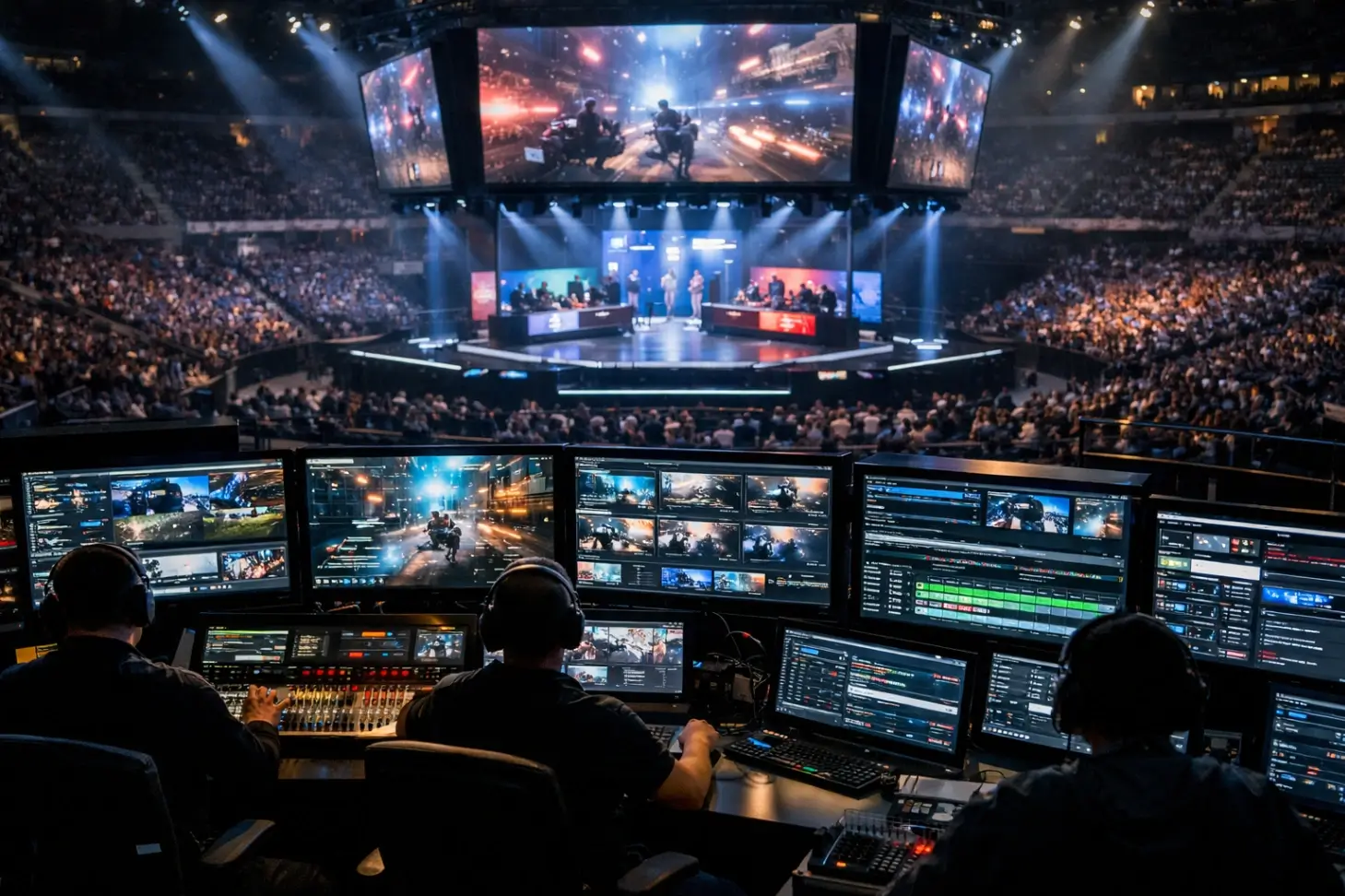
One of the defining components of Esports Broadcast Production Systems is the live production control room. This environment functions as the operational center of the entire broadcast, where directors, technical producers, observers, audio engineers, and graphics operators coordinate every second of the live show.
Unlike casual streaming setups, professional control rooms use multi-channel video switchers capable of handling dozens of input sources. These inputs may include player cameras, in-game observer feeds, audience cameras, stage cameras, replay channels, sponsor graphics, and commentator desks. The director selects which feed is visible to the audience at any given moment, ensuring the broadcast highlights the most important action.
The design of these control rooms often mirrors television studios, but with additional tools designed specifically for esports. For example, observers inside the game client act as virtual camera operators, selecting angles, tracking players, and controlling spectator views. Their work must stay synchronized with the broadcast director to ensure the final output matches the pace of the match.
Because of this coordination requirement, Esports Broadcast Production Systems are closely connected to performance monitoring platforms similar to those discussed in
Esports Performance Analytics Systems
, where real-time data can also be integrated into live overlays during matches.
Observer Tools and In-Game Camera Technology
Unlike traditional sports, esports broadcasts depend heavily on internal game camera systems. These observer tools are part of the competitive software itself and are designed to work with Esports Broadcast Production Systems to provide cinematic views of gameplay without interfering with players.
Most modern esports titles include dedicated spectator modes that allow observers to switch perspectives instantly, follow specific players, display tactical maps, or show slow-motion replays. These features are essential for professional broadcasts because matches often contain simultaneous actions happening across different areas of the map.
Observer technology must also support delayed feeds for referees and production staff. In some tournaments, the broadcast is intentionally delayed to prevent stream sniping or unfair information leaks. This means the production system must maintain multiple synchronized timelines at once, including the live match, the delayed broadcast, and the replay buffer.
The reliability of these observer tools is one of the reasons why only certain games can become successful esports titles. Developers must design their engines to support advanced viewing tools, otherwise large-scale broadcast production becomes difficult or impossible.
Replay Engines and Highlight Generation
Another essential component of Esports Broadcast Production Systems is the replay engine. During professional matches, replay operators constantly record gameplay feeds so important moments can be shown again from different angles. These replays are not only used for entertainment, but also for analysis, commentary, and referee verification.
Modern replay systems allow producers to mark key events in real time, store them in a timeline, and instantly load them into the broadcast switcher. This process must happen without interrupting the live match, which requires high-speed storage, fast encoding hardware, and precise synchronization.
Highlight generation has also become part of the commercial side of esports. Sponsors often request branded replays, slow-motion effects, or statistical overlays that appear during important plays. Because of this, Esports Broadcast Production Systems must support real-time graphics engines capable of rendering animations while the match continues.
These graphics layers are integrated into the production pipeline and must remain perfectly synchronized with the video feed. If overlays appear too early or too late, the broadcast can look unprofessional, which is unacceptable in major international tournaments.
Streaming Servers and Signal Distribution
After the live feed leaves the production switcher, it enters one of the most critical parts of Esports Broadcast Production Systems: signal encoding and distribution. This stage converts raw video into digital formats that can be delivered to streaming platforms, television networks, and online viewers around the world.
Encoding servers compress the video while maintaining quality, then send the stream to content delivery networks. These networks distribute the broadcast across multiple regions to reduce buffering and maintain stable playback for large audiences.
Major events often use multiple encoding profiles at different resolutions to support viewers with different internet speeds. This means the broadcast system must generate several versions of the same stream at once, all synchronized with the original match feed.
Because of the massive number of viewers involved, the stability of Esports Broadcast Production Systems directly affects the reputation of the tournament organizer. Even a short interruption can impact sponsors, teams, and viewers, making broadcast reliability one of the most important technical priorities in professional esports.
Live Spectator Systems and Arena Display Technology
Large international tournaments are designed not only for online viewers but also for live audiences inside arenas. Because of this, Esports Broadcast Production Systems must support both in-venue displays and global streaming at the same time. The production pipeline sends separate video feeds to giant stage screens, commentator monitors, referee stations, and online platforms simultaneously without breaking synchronization.
Arena display systems usually receive a customized version of the broadcast feed. This version may include different camera angles, reduced delay, or alternative overlays designed for spectators inside the venue. While online viewers often watch a slightly delayed stream, live audiences must see the action instantly to match the players performing on stage. Maintaining this balance requires precise timing control across the entire Esports Broadcast Production Systems architecture.
In major events, multiple LED walls, projection screens, and stage displays are connected to the same control room. Each display channel must remain perfectly synchronized with the match server and the observer feed. Even a one-second mismatch between screens can break immersion and reduce the professional quality of the event.
Audio Mixing, Commentary, and Communication Channels
Sound design is another critical layer inside Esports Broadcast Production Systems. Professional tournaments include multiple audio sources such as in-game sound, commentator microphones, stage announcements, audience reactions, and team voice channels. All of these signals must be mixed in real time before being sent to the broadcast output.
Audio engineers use digital mixing consoles that allow independent control of each source. For example, the broadcast may increase the volume of commentators during slow moments and emphasize game sound during intense fights. This dynamic mixing creates a cinematic experience that keeps viewers engaged throughout the match.
Communication channels are also built into the production system. Directors, observers, referees, and stage managers use private voice networks to coordinate the show. These communication lines must remain isolated from the public broadcast to avoid accidental leaks or competitive interference. Because of this, Esports Broadcast Production Systems often include dedicated intercom servers similar to those used in television studios.
Remote Production and Online Tournament Broadcasting
Not all tournaments take place inside arenas. Many modern competitions are produced remotely, where players compete from different locations while the broadcast team operates from a central studio. This format became more common as esports expanded globally and required flexible production environments.
Remote events place additional pressure on Esports Broadcast Production Systems because the production team must receive video feeds from multiple regions at the same time. Each feed must be synchronized, encoded, and combined into a single broadcast without noticeable delay.
To achieve this, organizers use secure network routing, backup connections, and cloud-based switching systems. These tools allow the broadcast to continue even if one location experiences technical problems. The ability to produce events remotely has allowed esports to maintain consistent schedules across different countries without requiring all players to travel.
This global structure works closely with the competitive infrastructure described in
Inside the Professional Esports Ecosystem
, where tournament organizers coordinate servers, teams, and production environments as part of a unified operational system.
Graphics Engines and Real-Time Data Integration
Modern broadcasts include far more than gameplay footage. Scoreboards, player statistics, sponsor animations, and tactical maps all appear on screen during matches. These visual elements are generated by graphics engines connected directly to Esports Broadcast Production Systems.
Graphics software receives data from the tournament server, analytics platforms, and referee tools, then converts that information into overlays visible to viewers. Because matches move quickly, these overlays must update in real time without interrupting the video feed.
Advanced tournaments also integrate performance metrics, damage statistics, and historical comparisons during live play. This data is similar to the analytical information used by teams internally, but in the broadcast environment it must be simplified for spectators while still remaining accurate.
The integration of live statistics has become one of the defining features of modern Esports Broadcast Production Systems, helping audiences understand complex matches and making professional play easier to follow.
Redundancy, Backup Systems, and Broadcast Stability
Reliability is one of the most important design goals of Esports Broadcast Production Systems. Major tournaments cannot risk losing the live signal during important matches, especially when millions of viewers and sponsors are involved. Because of this, production setups always include backup hardware, duplicate servers, and alternative network routes.
If the main encoding server fails, a secondary system immediately takes control without interrupting the stream. The same principle applies to audio mixers, switchers, and observer feeds. Every critical component has at least one backup running in parallel.
Large organizers also use redundant internet connections connected to different providers. This ensures that a network failure in one region does not stop the broadcast entirely. These precautions are expensive, but they are necessary for maintaining professional standards in modern esports.
The emphasis on stability shows how far Esports Broadcast Production Systems have evolved from simple online streams into full-scale media production environments comparable to traditional sports television.
The Future of Esports Broadcast Production Systems
As technology continues to evolve, Esports Broadcast Production Systems are expected to become even more advanced. Cloud production, virtual cameras, and automated replay tools are already being tested in professional leagues. These innovations allow tournaments to reduce costs while still delivering high-quality broadcasts to global audiences.
Virtual production environments may soon replace physical control rooms in some events. Instead of operating from a single location, producers could manage broadcasts through cloud platforms that combine video feeds, graphics, and audio in real time. This approach would allow tournaments to scale more easily and support competitions in multiple regions simultaneously.
Artificial intelligence is also being explored as part of future Esports Broadcast Production Systems. Automated observers could track important moments inside the game, while machine learning tools might generate highlights without human input. These technologies could reduce workload for production teams and improve consistency across broadcasts.
Despite these changes, the core purpose of the system will remain the same: delivering a clear, synchronized, and professional viewing experience without interfering with the competitive environment itself.
Conclusion
The success of modern tournaments depends on far more than player skill or game design. Behind every professional event stands a complex network of technologies known as Esports Broadcast Production Systems. These systems coordinate cameras, observers, audio, graphics, servers, and distribution networks to transform competitive matches into global entertainment.
From arena displays to online streaming platforms, every part of the broadcast pipeline must remain synchronized to maintain fairness and visual quality. Control rooms manage dozens of signals at once, replay engines capture key moments, and encoding servers deliver the final stream to viewers around the world.
As esports continues to grow, the importance of Esports Broadcast Production Systems will only increase. Future tournaments will require even more advanced infrastructure to support larger audiences, more complex games, and higher production standards. The technology behind the broadcast has become just as important as the competition itself, forming one of the foundations of the modern esports industry.