Procedural Generation Systems in Modern Games: The Technology Behind Infinite Worlds and Dynamic Content
Modern video games are no longer limited to small handcrafted environments. As hardware capabilities improved and player expectations increased, developers needed new ways to create massive worlds without consuming impossible amounts of memory or development time. This is where Procedural Generation Systems became one of the most important technologies in modern game development. These systems allow game engines to generate environments, objects, and gameplay elements dynamically using algorithms instead of storing everything as static data.
In modern gaming technology, Procedural Generation Systems are not only used to create large maps, but also to optimize performance, reduce storage usage, and enable dynamic content that reacts to player actions. Many modern engines combine procedural generation with advanced rendering, physics simulation, and asset streaming techniques to create seamless experiences without loading screens. Technologies like
Game Asset Streaming
work together with procedural generation to ensure that only the necessary data is loaded at the right time.
Understanding how Procedural Generation Systems work requires looking deeper into game engine architecture, algorithm design, and memory management. Unlike simple random generation, modern procedural systems rely on deterministic algorithms, noise functions, rule-based generation, and runtime simulation to maintain consistency while still creating dynamic content.
Core Architecture of Procedural Generation Systems
At the engine level, Procedural Generation Systems are built as modular components that can run during level creation, during loading, or even in real time while the game is running. The core idea is that instead of storing every object in memory, the engine stores rules and algorithms that can recreate those objects whenever needed. This approach dramatically reduces file size while allowing extremely large environments.
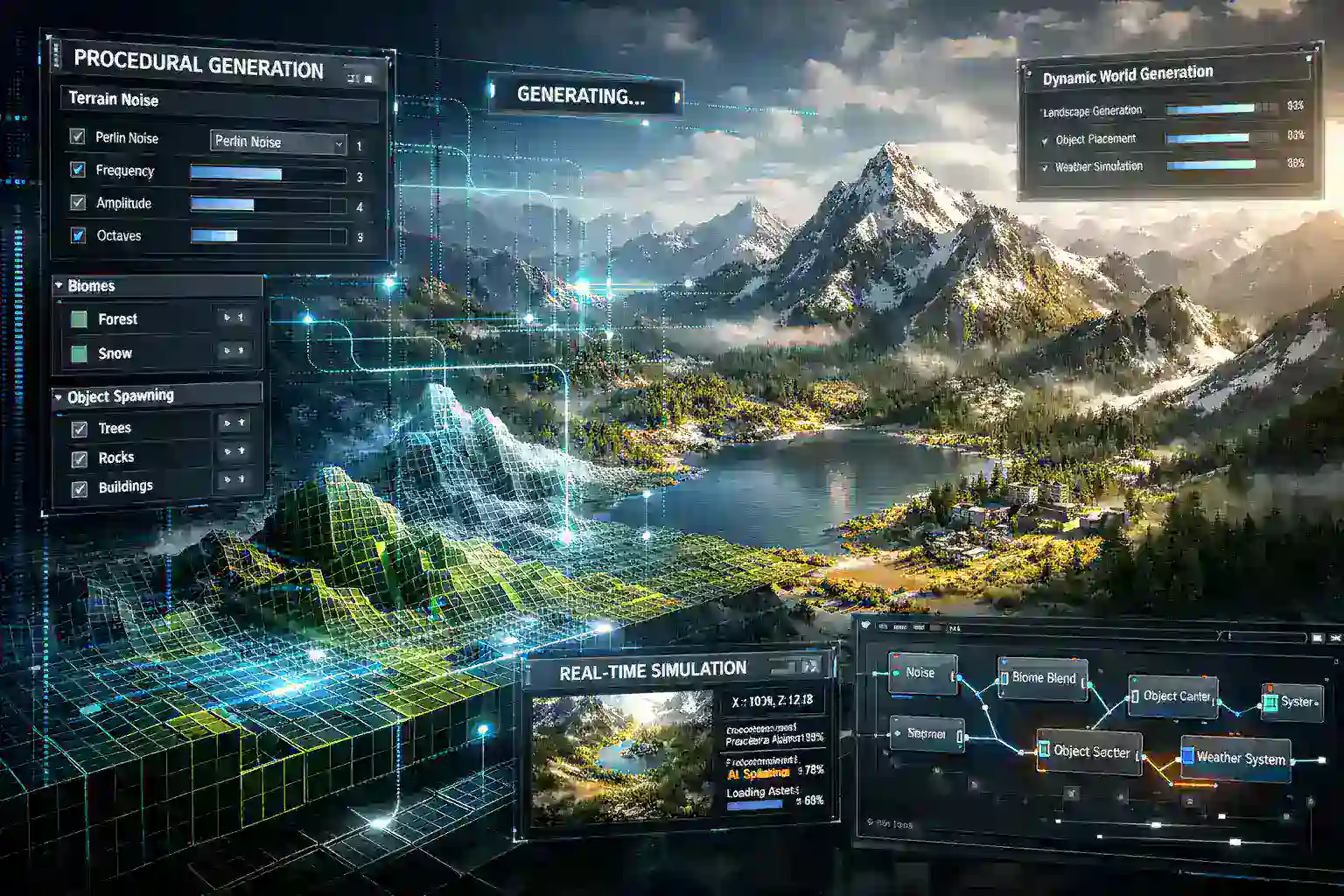
Most modern engines implement procedural generation using layered architecture. The first layer defines global rules, such as world size, terrain type, or biome distribution. The second layer generates geometry using mathematical functions, while the third layer adds details like vegetation, buildings, or interactive objects. Because these layers are separated, developers can control performance and memory usage more efficiently.
When combined with modern rendering pipelines, Procedural Generation Systems must also remain compatible with lighting, physics, and shader systems. For example, dynamically generated terrain must still interact correctly with lighting techniques such as
Real-Time Ray Tracing,
and materials must work with compiled shaders to maintain visual consistency.
Deterministic Algorithms and World Consistency
One of the biggest challenges in Procedural Generation Systems is maintaining consistency. If a world is generated dynamically, the engine must ensure that the same location always produces the same result when revisited. This is achieved using deterministic algorithms, which generate identical output when given the same input values.
Game engines typically use seed values to control procedural generation. A seed is a number that defines the starting state of the algorithm. When the same seed is used, the same world can be generated again without storing the entire environment. This method allows developers to create extremely large worlds while keeping save files small.
Deterministic generation also makes it possible to synchronize multiplayer environments. Instead of sending large amounts of map data over the network, the game only needs to send the seed value and generation parameters. Each client can then recreate the same world locally using the same Procedural Generation Systems.
Noise Functions and Terrain Generation
Terrain generation is one of the most common uses of Procedural Generation Systems. Instead of modeling landscapes manually, developers use mathematical noise functions to create natural-looking terrain. These functions generate smooth variations that simulate mountains, valleys, caves, and rivers.
Perlin noise, Simplex noise, and fractal noise are widely used in modern engines. These algorithms produce continuous values that can be interpreted as height, density, or temperature. By combining multiple noise layers, developers can create complex environments that look handcrafted even though they are generated automatically.
Modern procedural terrain systems also integrate with physics engines to ensure accurate collision detection and realistic movement. When terrain is generated dynamically, the physics system must update collision meshes in real time. This requires tight integration between Procedural Generation Systems and simulation technologies such as
Game Physics Engine Architecture.
Procedural Generation in Open World Game Design
Open world games rely heavily on Procedural Generation Systems because manually building huge environments is not practical. Even when developers create handcrafted locations, procedural tools are often used to fill large areas with terrain, vegetation, or background structures.
In modern engines, procedural generation can run both offline and in real time. Offline generation is used during development to create base environments, while runtime generation is used to create dynamic content during gameplay. This hybrid approach allows developers to keep artistic control while still benefiting from automation.
Procedural generation is also important for replayability. Games that use dynamic content can create different experiences every time the player starts a new session. Instead of memorizing level layouts, players must adapt to new environments generated by the engine.
Memory Optimization and Storage Efficiency
One of the main reasons Procedural Generation Systems became essential in modern gaming is storage limitation. High-resolution textures, detailed models, and large worlds require massive amounts of data. Without procedural generation, game sizes would become too large to distribute efficiently.
By storing rules instead of assets, procedural systems allow engines to reconstruct content when needed. This reduces disk usage and also improves loading speed. Instead of reading large files, the engine can generate content using CPU or GPU calculations.
This approach works especially well when combined with streaming systems. Asset streaming loads only the visible parts of the world, while procedural generation creates additional details on demand. Together, these technologies make it possible to build seamless environments that appear much larger than the actual stored data.
Integration with Modern Rendering Pipelines
Modern rendering systems require high consistency between geometry, lighting, and materials. Because of this, Procedural Generation Systems must be fully integrated with the rendering pipeline. Generated objects must support shaders, reflections, shadows, and global illumination just like handcrafted assets.
This integration becomes more complex when advanced rendering techniques are used. Shader compilation, for example, must work correctly even when materials are generated at runtime. Many engines use optimized pipelines similar to those described in
Shader Compilation in Games
to ensure that dynamically generated objects do not cause performance spikes.
Because of these requirements, procedural generation is no longer a simple feature. It is now a core part of engine architecture, deeply connected to rendering, physics, memory management, and asset streaming.
Dynamic Content and Runtime Generation
Modern Procedural Generation Systems are designed to work during gameplay, not only during loading. This allows games to generate missions, environments, or events dynamically based on player behavior. Runtime generation makes games feel more responsive and less predictable.
Dynamic generation also reduces the need for massive development teams. Instead of building thousands of unique assets, developers can design generation rules that produce many variations automatically. This approach is widely used in sandbox games, simulation games, and large open world projects.
However, runtime generation requires careful optimization. Generating content while the game is running can affect performance if not managed correctly. Modern engines solve this problem using multithreading, background generation, and GPU acceleration.
In the second part of this article, we will explore advanced techniques used in Procedural Generation Systems, including rule-based generation, modular world building, performance challenges, and the future of procedural technology in modern game engines.
Rule-Based Generation and Modular World Building
Advanced Procedural Generation Systems do not rely only on random numbers or noise functions. Modern engines use rule-based generation to maintain logical consistency in dynamically created environments. Instead of generating objects freely, the system follows predefined rules that control placement, scale, and relationships between elements. This approach allows developers to create worlds that feel designed even though they are generated automatically.
Rule-based generation is commonly used for cities, dungeons, and interior spaces. For example, a procedural city generator may follow rules that define road width, building height, and district layout. Because the rules are consistent, the generated environment looks believable and structured. This technique is essential for large games where manually creating every location would be impossible.
Modular world building is another important part of modern Procedural Generation Systems. Instead of generating everything from scratch, the engine uses small reusable modules that can be combined in different ways. These modules may include building parts, terrain pieces, or environment props. By assembling modules procedurally, the engine can create thousands of variations while keeping memory usage low.
Runtime Performance Challenges
While Procedural Generation Systems provide major advantages, they also introduce performance challenges. Generating content during gameplay requires CPU time, memory allocation, and synchronization with other engine systems. If generation is not optimized, the player may experience frame drops or delays.
Modern engines solve this problem using asynchronous generation. Instead of creating content on the main thread, the engine generates objects in the background and loads them only when ready. This prevents the game from freezing while new content is being created. Multithreading and task scheduling are essential for making procedural generation work in real time.
Another challenge is balancing generation quality and performance. High-detail generation requires more calculations, which can affect frame rate. Because of this, developers often use level-of-detail systems together with Procedural Generation Systems. Objects far from the player are generated with less detail, while nearby objects use full resolution.
Procedural Generation and Artificial Intelligence Systems
Modern Procedural Generation Systems are increasingly connected with artificial intelligence. Instead of using simple rules, some engines use AI-driven algorithms to create more realistic environments. These systems can analyze terrain, adjust object placement, and generate content that adapts to gameplay conditions.
AI-assisted procedural generation is especially useful for creating natural environments. Forests, caves, and rock formations can be generated using simulation-based algorithms that mimic real-world processes. This produces results that look more organic than traditional noise-based generation.
Procedural AI systems can also be used to generate gameplay content, such as missions, enemy placement, or loot distribution. Because the generation reacts to player actions, the game feels less repetitive. This dynamic behavior is one of the main reasons Procedural Generation Systems are widely used in modern sandbox and simulation games.
Networking and Multiplayer Synchronization
In multiplayer games, Procedural Generation Systems must ensure that all players see the same world. Sending full environment data over the network would require too much bandwidth, so most engines send only generation parameters. Each client then recreates the same world locally using the same algorithms and seed values.
This technique reduces network traffic and makes large worlds possible even in online games. However, synchronization must be precise. If one client generates a different result, gameplay problems can occur. Because of this, deterministic algorithms are required for multiplayer procedural generation.
Modern networking engines also combine procedural generation with streaming technology. Instead of generating the entire world at once, the engine creates only the parts needed by each player. This keeps memory usage stable even in very large environments.
Procedural Animation and Object Variation
Not all Procedural Generation Systems are used for terrain or maps. Many engines use procedural techniques to create animations, object variations, and visual effects. For example, vegetation movement, cloth simulation, and particle behavior can all be generated using procedural rules instead of predefined animations.
Procedural variation makes the game world feel less repetitive. Instead of placing identical objects everywhere, the engine can slightly change size, rotation, color, or shape. These small differences make environments look more realistic without requiring additional assets.
Because these variations are generated at runtime, they must remain compatible with rendering and physics systems. Every generated object still needs correct collision detection, shading, and lighting. This is why Procedural Generation Systems must be deeply integrated with the core engine architecture.
Future Evolution of Procedural Technology
The role of Procedural Generation Systems continues to grow as games become more complex. Future engines are expected to rely even more on procedural technology to create worlds that are too large to store traditionally. Instead of building fixed environments, developers will design systems that can generate content endlessly.
New hardware capabilities also make procedural generation more practical. Modern CPUs and GPUs can handle large amounts of parallel computation, which allows real-time generation without affecting performance. As graphics technology advances, procedural systems will need to support more detailed geometry, advanced lighting, and complex physics interactions.
Machine learning may also become part of future Procedural Generation Systems. Instead of writing rules manually, developers could train models to generate environments automatically. This could reduce development time while increasing visual diversity.
Procedural Generation as a Core Engine Technology
In modern game development, Procedural Generation Systems are no longer optional tools. They are fundamental parts of engine architecture, working together with rendering, physics, streaming, and memory management. Without procedural generation, many of today’s large-scale games would not be possible.
The ability to generate content dynamically allows developers to build worlds that feel alive, unpredictable, and extremely large without requiring impossible amounts of storage. Because of this, procedural generation will remain one of the most important technologies in gaming for the foreseeable future.
For developers, understanding how Procedural Generation Systems interact with other engine components is essential for building high-performance games. For players, these systems make it possible to explore worlds that continue to grow, change, and evolve every time the game is played.
Conclusion
Modern Procedural Generation Systems represent one of the most powerful technologies in game engine design. By combining deterministic algorithms, noise functions, rule-based generation, and runtime optimization, developers can create massive environments without sacrificing performance or storage efficiency.
As game engines continue to evolve, procedural generation will become even more advanced, allowing developers to create dynamic content on a scale that was not possible before. From terrain creation to animation, from multiplayer synchronization to AI-driven environments, Procedural Generation Systems remain at the center of modern gaming technology.
Focus Keyword
Procedural Generation Systems
Meta Description
Procedural Generation Systems in modern games explained in depth, including algorithms, runtime generation, performance optimization, and how game engines create massive dynamic worlds without storing huge amounts of data.
Tags
procedural generation, procedural generation systems, game engine technology, game development, gaming technology, open world games, game optimization, rendering engine, game physics, shader systems, asset streaming, dynamic content, game design technology
External References
Procedural generation – Wikipedia