Input Latency in PC Gaming: The Hardware-Level Chain Between Action and On-Screen Response
Competitive gaming performance is often discussed in terms of frame rates, graphics quality, and raw hardware power. Yet beneath these visible metrics lies a less obvious but critically important factor that directly shapes player experience: input latency. Unlike visual artifacts or performance drops, latency is not something players can easily see, but it is constantly felt through responsiveness, control precision, and the perceived connection between physical actions and digital outcomes.
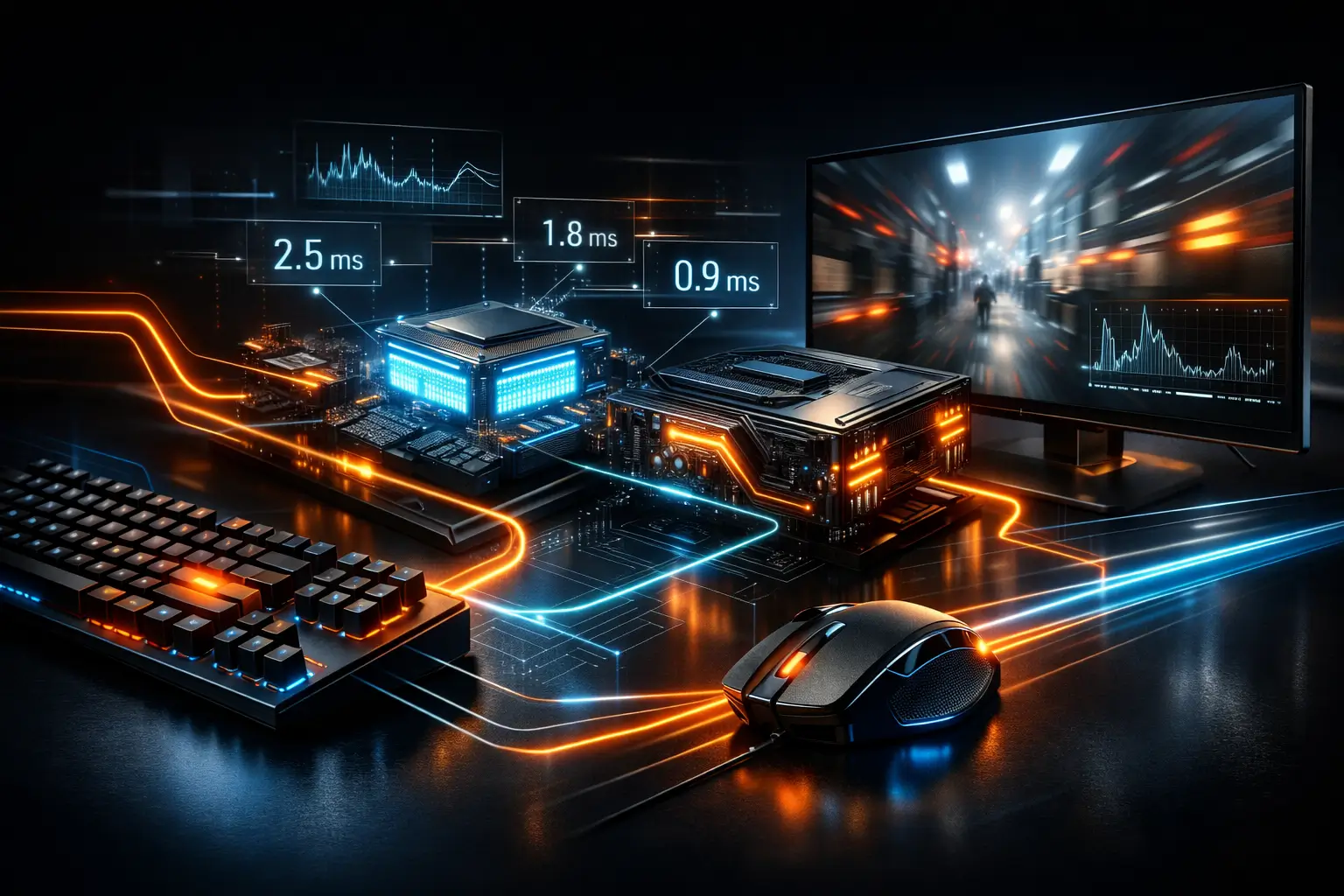
Input latency describes the total time required for a user action to translate into a visible change on the display. This delay exists in every interactive system, regardless of performance level. Even the fastest gaming PCs operate through a chain of processes, each introducing small but measurable delays. Understanding this chain reveals why two systems with identical frame rates may deliver noticeably different gameplay experiences.
In modern PC gaming environments, latency is not defined by a single component. Instead, it emerges from the interaction between input devices, operating system behavior, processor scheduling, graphics pipeline mechanics, and display technologies. The cumulative effect of these stages determines how quickly the virtual world reacts to the player.
The Invisible Nature of Input Latency
One of the defining characteristics of input latency is its invisibility. While low frame rates manifest as stutter or choppiness, latency can remain hidden even in visually smooth scenarios. A game may render at high FPS while still feeling sluggish or unresponsive. This apparent contradiction highlights a fundamental distinction between throughput and delay. Frame rate measures how many frames are produced per second, whereas latency measures how long it takes for a specific action to influence a frame.
Perceived responsiveness relies heavily on this timing relationship. Human motor control systems are remarkably sensitive to delays between intention and feedback. Small increases in latency can alter aiming accuracy, tracking stability, and reaction timing. These effects become especially pronounced in fast-paced genres where microsecond-level differences influence competitive outcomes.
Input Devices as the First Latency Stage
The latency chain begins at the physical interface between the player and the machine. Keyboards, mice, and controllers operate through scanning and polling mechanisms that determine how frequently input states are sampled. Polling rate directly influences the earliest possible detection of user actions. Higher polling frequencies reduce the time between a physical movement and its registration by the system.
However, device-level latency is not solely defined by polling speed. Sensor processing, signal debouncing, firmware logic, and communication protocols all contribute to response timing. Even before data reaches the operating system, multiple micro-operations have already occurred. These stages form the foundation upon which the remainder of the latency pipeline is built.
Operating System Scheduling and Event Handling
Once input signals enter the host system, they become subject to operating system scheduling policies. Modern operating systems manage thousands of concurrent processes, balancing background tasks, driver operations, and application threads. Input events must compete for CPU time alongside other system activities.
This scheduling environment introduces variability. Latency is not always constant; it fluctuates based on workload, thread priority, and system interrupts. Under heavy CPU load, input processing may experience subtle delays even when overall performance metrics appear stable. These dynamics illustrate why responsiveness cannot be evaluated through graphics hardware alone.
CPU Processing and Simulation Timing
After input events are processed by the operating system, they are delivered to the game engine. At this stage, the CPU interprets player actions within the simulation framework. Movement updates, physics calculations, collision detection, and game logic execution all occur before rendering begins.
Simulation timing significantly influences input latency. Game engines operate through discrete update cycles, meaning inputs are incorporated at specific intervals rather than continuously. The alignment between input arrival and simulation steps determines when a player action affects the virtual state. Delays introduced here are independent of GPU speed, reinforcing the multi-stage nature of latency.
The Render Queue and Frame Submission
Rendering introduces another layer of delay. Frames are typically prepared in advance through buffering mechanisms designed to maximize throughput and stability. While buffering improves visual smoothness, it can also increase latency by storing frames before display output.
The render queue represents a critical junction in the latency chain. Frames waiting in the queue reflect actions that have already been processed but not yet presented. Queue depth, synchronization strategies, and driver behavior all influence how quickly new input effects reach the screen.
Latency-related phenomena are often associated with frame pacing irregularities. Systems that struggle with consistent frame delivery may exhibit compounding responsiveness issues. This relationship becomes clearer when considering how frame timing stability interacts with responsiveness characteristics, as explored in discussions surrounding Frame Time Consistency.
GPU Pipeline Behavior
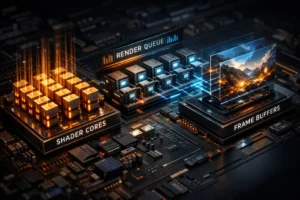
Within the graphics processor, workloads are executed through deeply parallel pipelines optimized for throughput rather than immediate response. Shader execution, memory access, rasterization, and post-processing stages collectively determine frame completion time.
Although GPUs are frequently evaluated by raw performance metrics, their contribution to input latency depends on pipeline occupancy and synchronization behavior. High utilization can improve frame rates while simultaneously increasing response delays if frames accumulate within buffers or scheduling queues.
Thermal conditions further complicate GPU responsiveness. Clock adjustments triggered by temperature constraints can alter processing timing characteristics. These interactions demonstrate why thermal management directly affects not only performance ceilings but also latency-sensitive behavior, a concept examined in analyses of GPU Thermal Throttling.
Display Processing and Pixel Response
The final stage of the latency pipeline occurs at the display level. Once frames exit the GPU, they undergo additional processing, including scaling, color correction, overdrive adjustments, and panel response transitions. Each operation adds incremental delay.
Pixel response time and internal display buffers influence how quickly visual updates become visible. Even when frames are delivered rapidly, panel characteristics determine the physical manifestation of changes. This stage completes the action-to-photon chain that defines end-to-end latency.
Collectively, these stages illustrate that input latency is not a singular measurement but an emergent property of the entire system. Evaluating responsiveness requires examining interactions across hardware, software, and display domains rather than focusing on isolated specifications.
Latency Accumulation and System-Level Interactions
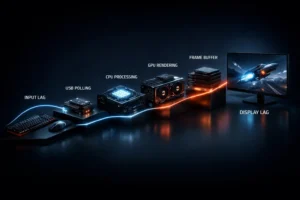
End-to-end responsiveness is governed not by isolated delays but by latency accumulation across the entire execution chain. Each stage in the pipeline contributes a fraction of the total delay, yet their combined effect determines how input latency is ultimately perceived. Small inefficiencies, even those measured in microseconds, compound as signals traverse hardware queues, driver layers, and scheduling boundaries.
This cumulative behavior explains why optimizations targeting a single component rarely produce dramatic improvements. A faster graphics card cannot fully compensate for delays introduced by CPU scheduling, just as high polling rates cannot eliminate buffering-induced lag. Input latency emerges from coordination between subsystems rather than raw speed alone.
Frame Production Versus Response Timing
A common misconception equates higher frame rates with lower latency. While throughput and delay are related, they are not interchangeable. Systems capable of generating large numbers of frames per second may still exhibit elevated input latency depending on queue depth, synchronization policy, and simulation timing. Frames rendered quickly but displayed later do not enhance responsiveness.
The temporal relationship between input sampling and frame presentation is more significant than absolute FPS values. When input events are captured early in the frame cycle, their effects propagate with minimal delay. Conversely, inputs arriving after simulation cutoffs must wait for subsequent cycles, extending effective latency even under high-performance conditions.
Driver Queues and Command Buffer Dynamics
Graphics drivers operate as intermediaries between software and hardware execution units. Their buffering strategies influence workload distribution, stability, and latency characteristics. Deep command queues improve utilization efficiency but can increase input latency by allowing frames to accumulate before execution.
Modern driver architectures attempt to balance throughput with responsiveness through adaptive queue management. However, workload spikes, background processes, and scheduling contention can still alter queue behavior. These dynamics highlight the variability inherent in latency-sensitive systems.
Display Synchronization and Latency Tradeoffs
Display synchronization mechanisms introduce complex latency tradeoffs. Techniques designed to eliminate tearing or maintain visual coherence frequently alter the timing of frame presentation. Vertical synchronization, adaptive refresh technologies, and variable refresh rate systems each reshape the latency landscape in distinct ways.
Synchronization policies influence when frames are allowed to reach the display engine. Under certain conditions, these policies intentionally delay presentation to maintain consistency. Although visually beneficial, these delays contribute directly to input latency, reinforcing the distinction between smoothness and responsiveness.
Simulation Granularity and Engine Architecture
Game engine design exerts a profound influence on latency behavior. Simulation granularity, update frequency, and thread partitioning determine how rapidly input events modify virtual state. Engines operating with coarse update intervals inherently introduce larger response windows, affecting input latency regardless of hardware capability.
Threaded architectures further complicate timing relationships. Input processing, physics evaluation, AI logic, and rendering preparation may occur asynchronously, introducing synchronization points that alter delay characteristics. The structure of these execution models defines latency behavior as much as component performance.
CPU Bottlenecks and Latency Amplification
Processor-level bottlenecks often manifest as latency amplification rather than obvious performance collapse. When CPU resources become constrained, scheduling delays propagate through simulation, command submission, and frame preparation stages. These effects elevate input latency even when frame rates remain within acceptable ranges.
Workload contention, cache behavior, and thread scheduling policies collectively shape response timing. Latency-sensitive workloads are particularly vulnerable to variability introduced by background activity and resource arbitration.
GPU Workload Saturation Effects
Graphics processors optimized for parallel throughput may experience latency-related side effects under sustained saturation. Heavy shader workloads, memory transactions, and post-processing stages increase frame completion times and influence queue residency. Elevated pipeline occupancy can indirectly raise input latency by extending frame lifetimes within buffers.
Memory behavior is especially relevant in this context. Bandwidth limitations, cache interactions, and memory scheduling policies shape execution timing, illustrating how architectural constraints affect responsiveness. These relationships mirror broader performance considerations associated with GPU Memory Bandwidth.
Measurement Complexities and Misinterpretations
Quantifying input latency presents significant methodological challenges. Measurement tools vary in precision, sampling strategy, and scope. Some metrics capture device-level delay, while others evaluate end-to-end response time. Discrepancies between measurement techniques often lead to conflicting interpretations.
Latency values must therefore be contextualized. Absolute numbers convey limited meaning without understanding the measurement boundaries, synchronization state, and workload conditions under which they were obtained. Comparative analysis provides greater insight than isolated figures.
Human Perception and Latency Sensitivity
Human sensitivity to delay varies based on interaction type, task complexity, and cognitive expectation. Fast-paced scenarios amplify the perceptual impact of input latency, particularly when precision timing or rapid corrective actions are required. In contrast, slower interactions may mask moderate delays without noticeable degradation.
Perception is shaped not only by magnitude but also by consistency. Stable latency often feels more responsive than fluctuating delays, even when average values are similar. Temporal predictability enhances motor control adaptation and reduces perceived sluggishness.
System Design Priorities and Practical Implications
Latency-aware system design emphasizes balanced optimization rather than singular performance targets. Hardware selection, driver configuration, operating system tuning, and display behavior collectively determine responsiveness outcomes. Improvements achieved in one stage may be negated by inefficiencies elsewhere.
Understanding input latency as a system-level property reframes performance evaluation. Instead of focusing exclusively on throughput metrics, responsiveness analysis considers scheduling coordination, queue management, and timing alignment across execution domains.
External References
Further technical context on latency behavior, rendering pipelines, and display timing can be explored through publicly available research and documentation. Authoritative discussions on graphics pipeline mechanics and system latency characteristics are available from sources such as Blur Busters and AnandTech, both widely recognized for detailed hardware analysis.
Collectively, these perspectives reinforce a central principle: input latency is neither accidental nor trivial. It is a predictable consequence of multi-stage execution pipelines, scheduling hierarchies, and synchronization policies that define modern interactive computing systems.