GPU Thermal Throttling: The Silent Performance Killer in Modern Graphics Cards
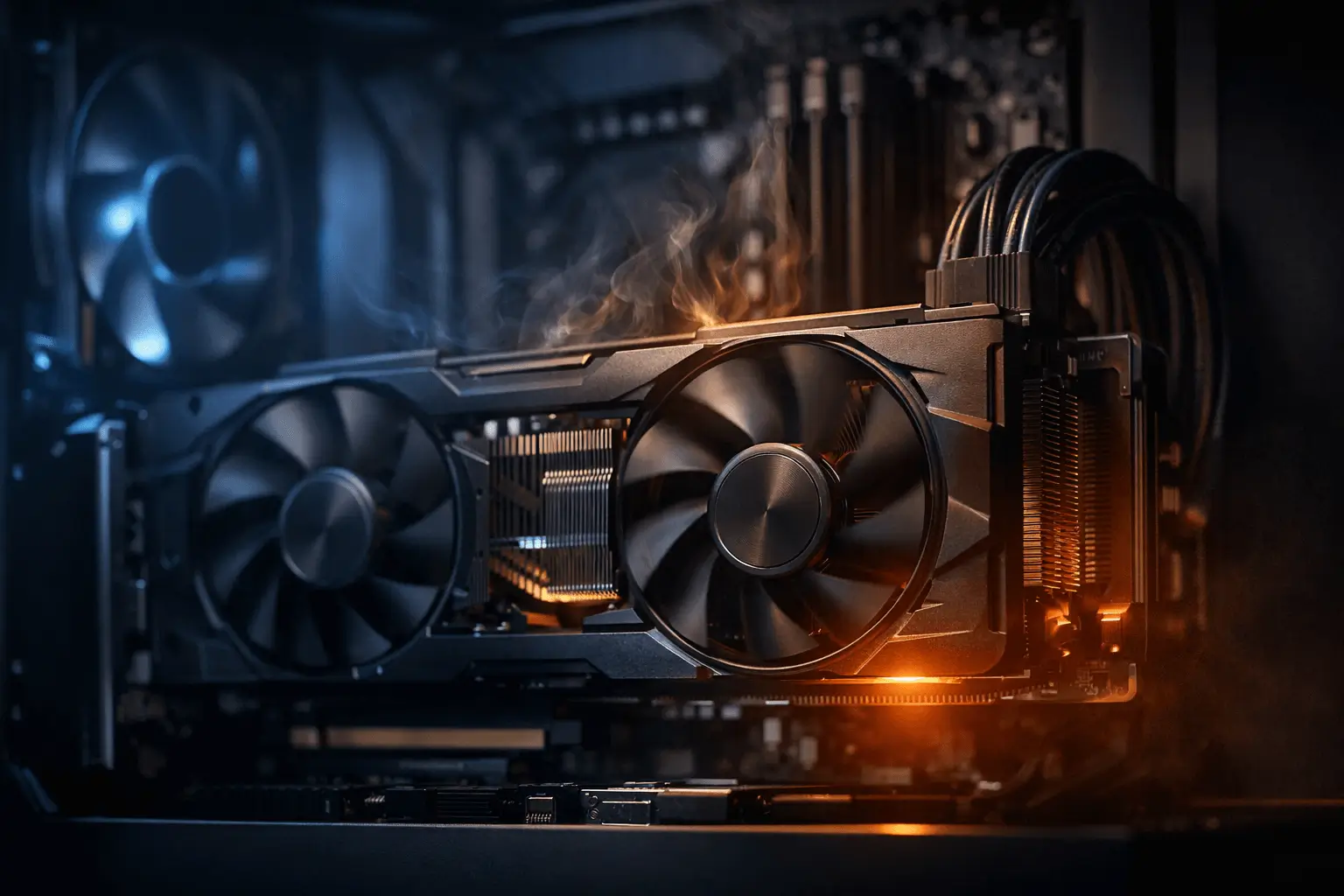
Modern graphics cards deliver extraordinary computational power, enabling realistic lighting, high frame rates, and complex visual effects once thought impossible. Yet beneath this technological achievement lies a limitation that rarely receives the attention it deserves: heat. No matter how advanced a GPU architecture becomes, temperature remains an unavoidable constraint. When thermal boundaries are reached, protective mechanisms activate — often invisibly to the player — altering performance characteristics in ways that can significantly impact the gaming experience. This phenomenon, known as GPU thermal throttling, represents one of the most misunderstood aspects of gaming hardware behavior.
The Invisible Nature of Performance Degradation
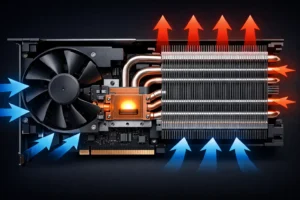
Unlike dramatic hardware failures or obvious frame drops caused by insufficient system resources, GPU thermal throttling is subtle. A system may appear fully functional while quietly reducing clock speeds, adjusting voltage curves, or modifying boost behavior to prevent overheating. The result is not a crash or error message, but a gradual erosion of performance headroom. Frame pacing may become inconsistent, peak frame rates may decline, and latency characteristics may shift — all without any clear indication of the underlying cause. For many users, this leads to misdiagnosis, where drivers, game patches, or background processes are blamed instead of temperature dynamics.
This invisibility makes thermal behavior uniquely problematic. A graphics card operating near its limits can deliver benchmark results that look impressive during short tests yet fail to sustain that performance during extended gaming sessions. The difference between synthetic performance and sustained performance often traces back to thermal conditions. In practice, the GPU’s true capability is defined not only by silicon design but also by cooling efficiency, airflow patterns, ambient temperature, and workload intensity.
Heat as a Fundamental Constraint
Every modern GPU is designed with predefined thermal targets. These limits are not arbitrary; they reflect electrical tolerances, material constraints, and long-term reliability considerations. As transistor density increases and power budgets expand, thermal density rises accordingly. Even highly efficient architectures generate substantial heat under load. When cooling solutions fail to dissipate this heat rapidly enough, internal safeguards respond. GPU thermal throttling therefore emerges not as a defect but as a protective strategy embedded into the hardware itself.
Importantly, throttling does not necessarily indicate poor hardware quality. Even premium graphics cards can encounter thermal restrictions depending on case design, dust accumulation, fan curves, or environmental factors. Compact cases, restricted airflow, and high ambient temperatures amplify thermal stress. Conversely, well-optimized cooling environments can unlock higher sustained clocks without altering the GPU’s core design.
Clock Speeds, Boost Algorithms, and Thermal Headroom
Modern GPUs rely heavily on dynamic boost technologies rather than fixed frequencies. These algorithms continuously evaluate temperature, power draw, and voltage conditions to determine safe operating speeds. Thermal headroom becomes a currency that directly influences performance. When temperatures remain low, boost clocks can rise aggressively. As temperatures approach critical thresholds, frequency reductions occur. This dynamic relationship means that GPU thermal throttling can reshape performance profiles moment by moment.
The practical implication is profound: two identical graphics cards can exhibit different real-world performance solely due to thermal conditions. Reviews and benchmarks often emphasize peak boost numbers, but sustained behavior matters more for gaming stability. A GPU that frequently encounters GPU thermal throttling may deliver inconsistent results despite strong theoretical specifications.
Gaming Workloads and Thermal Stress
Not all workloads stress a GPU equally. Graphically intensive scenes, ray tracing calculations, high resolutions, and uncapped frame rates dramatically increase power consumption. Competitive titles with high frame rate targets can drive continuous utilization, while visually rich single-player games create fluctuating thermal patterns. Over time, prolonged high utilization can push temperatures toward throttling thresholds, particularly in systems with marginal airflow.
Thermal behavior also interacts with frame time characteristics. While concepts like frame pacing and rendering stability are often discussed from a software perspective, hardware thermals play a crucial role. Performance irregularities sometimes attributed to engine optimization may actually originate from GPU thermal throttling. Readers interested in performance smoothness may find it useful to revisit discussions surrounding frame behavior, such as our analysis of internal timing dynamics in gaming systems.
For broader context on performance consistency and perceived smoothness, see:
Frame Time Consistency: The Invisible Factor Behind Truly Smooth Gaming.
Long-Term Consequences of Persistent Heat
Temperature does not merely influence short-term clock speeds. Sustained high temperatures can affect component aging, fan wear, thermal paste degradation, and voltage regulation efficiency. Repeated exposure to elevated thermal conditions may accelerate material fatigue, potentially shortening hardware lifespan. While GPU thermal throttling protects against immediate damage, chronic thermal stress can still impose gradual costs.
Understanding thermal behavior therefore extends beyond maximizing frame rates. It touches reliability, acoustic performance, power efficiency, and long-term system stability. Heat management becomes a defining variable in the overall health of a gaming system, influencing not just speed but endurance.
Cooling Design and Real-World Efficiency
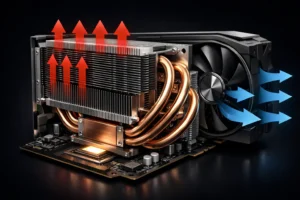
Cooling solutions represent the frontline defense against GPU thermal throttling. Heatsink mass, heat pipe layout, vapor chamber implementation, fan blade geometry, and airflow direction all shape thermal outcomes. Marketing materials often highlight aesthetic elements, yet thermal engineering remains the decisive factor. A visually striking GPU with inadequate cooling can underperform compared to a less flashy but thermally optimized design.
Case airflow further complicates this equation. Even the most advanced GPU cooler cannot function effectively in a poorly ventilated enclosure. Air recirculation, cable obstruction, and dust buildup can dramatically elevate operating temperatures. Over time, these factors increase the probability of GPU thermal throttling, particularly during extended gaming sessions or high-intensity workloads.
Ambient Temperature and Environmental Variables
External conditions play a larger role than many users realize. Room temperature directly influences baseline GPU thermals, altering boost behavior and thermal headroom. A graphics card operating comfortably in a cool environment may encounter GPU thermal throttling in warmer climates or confined spaces. Seasonal changes, ventilation quality, and system placement all affect heat dissipation.
This sensitivity explains why performance can vary between users despite identical hardware configurations. Thermal physics does not adapt to expectations; it responds only to environmental constraints. Recognizing this reality allows more accurate interpretation of performance fluctuations.
Monitoring, Diagnostics, and Misinterpretation
Temperature monitoring tools provide valuable insight, yet interpretation requires nuance. Observing clock speed reductions without correlating thermal data may lead to incorrect conclusions. Because GPU thermal throttling often operates gradually, performance degradation can appear inconsistent or situational. Without careful observation, users may attribute the issue to drivers, game updates, or background tasks.
Authoritative technical resources offer deeper explanations of GPU behavior and thermal design principles. Detailed investigations from hardware analysis platforms such as
GamersNexus
provide empirical measurements and thermal breakdowns that clarify these mechanisms.
Performance Stability Versus Peak Performance
Peak clock speeds attract attention, but stability defines the lived experience. A GPU capable of maintaining consistent frequencies under load often delivers superior real-world smoothness compared to one that repeatedly encounters GPU thermal throttling. Thermal stability influences frame delivery regularity, latency predictability, and workload consistency.
These characteristics intersect with broader game system design considerations. Hardware limitations, rendering behavior, and simulation complexity collectively shape perceived performance. Readers exploring systemic influences on gameplay experience may appreciate related discussions, such as:
Game Mechanics Explained: Powerful Core Systems That Truly Shape Modern Video Games.
Thermal Behavior as a Hardware Identity
In many respects, thermal behavior becomes part of a GPU’s identity. Beyond raw specifications, cooling efficiency and sustained performance differentiate products within the same tier. Two GPUs with similar compute capabilities can diverge significantly under prolonged load if one experiences frequent GPU thermal throttling.
This reality reshapes how hardware comparisons should be evaluated. Architectural advances, memory configurations, and theoretical throughput matter, but thermal dynamics ultimately determine practical outcomes. Heat is not a peripheral concern — it is a governing factor.
Conclusion: Performance Is a Thermal Story
Graphics card performance is often framed as a contest of cores, frequencies, and memory bandwidth. Yet temperature silently mediates these attributes, influencing how hardware behaves under real workloads. GPU thermal throttling embodies this thermal narrative, acting as both guardian and limiter. Recognizing its impact allows more informed hardware choices, better diagnostic accuracy, and more realistic expectations of sustained performance.
In the evolving landscape of gaming hardware, raw power continues to grow, but thermal physics remains unchanged. Understanding this balance transforms the way performance is perceived — revealing that smooth, stable gaming is as much a cooling challenge as it is a silicon achievement.