Frame Time Consistency: The Invisible Factor Behind Truly Smooth Gaming
Modern gaming discussions are dominated by one familiar metric: frames per second. Players compare numbers, celebrate higher values, and often assume that performance can be fully described by FPS alone. Yet real gameplay experience frequently tells a different story. Two systems running at identical frame rates can feel dramatically different. One appears fluid and responsive, while the other feels unstable, jittery, or strangely uncomfortable despite reporting impressive numbers.
This gap between measured performance and perceived smoothness is where frame time consistency becomes critically important. Unlike raw frame rate, which merely counts how many frames are rendered per second, frame timing reveals how evenly those frames are delivered. Human perception is highly sensitive to irregularities in visual motion, and small timing deviations can significantly affect how gameplay feels. For more insights into core gameplay systems, check out our article on Game Mechanics Explained.
Understanding frame time consistency provides a more accurate picture of gaming performance, helping players interpret stutters, input irregularities, and the subtle instability that traditional metrics often hide. It shifts the conversation from “how many frames” to “how those frames behave over time,” which is far closer to what actually defines smooth gameplay. For external references on frame timing and smoothness, NVIDIA provides detailed documentation on GPU timing and rendering pipelines.
The Difference Between Frame Rate and Frame Timing
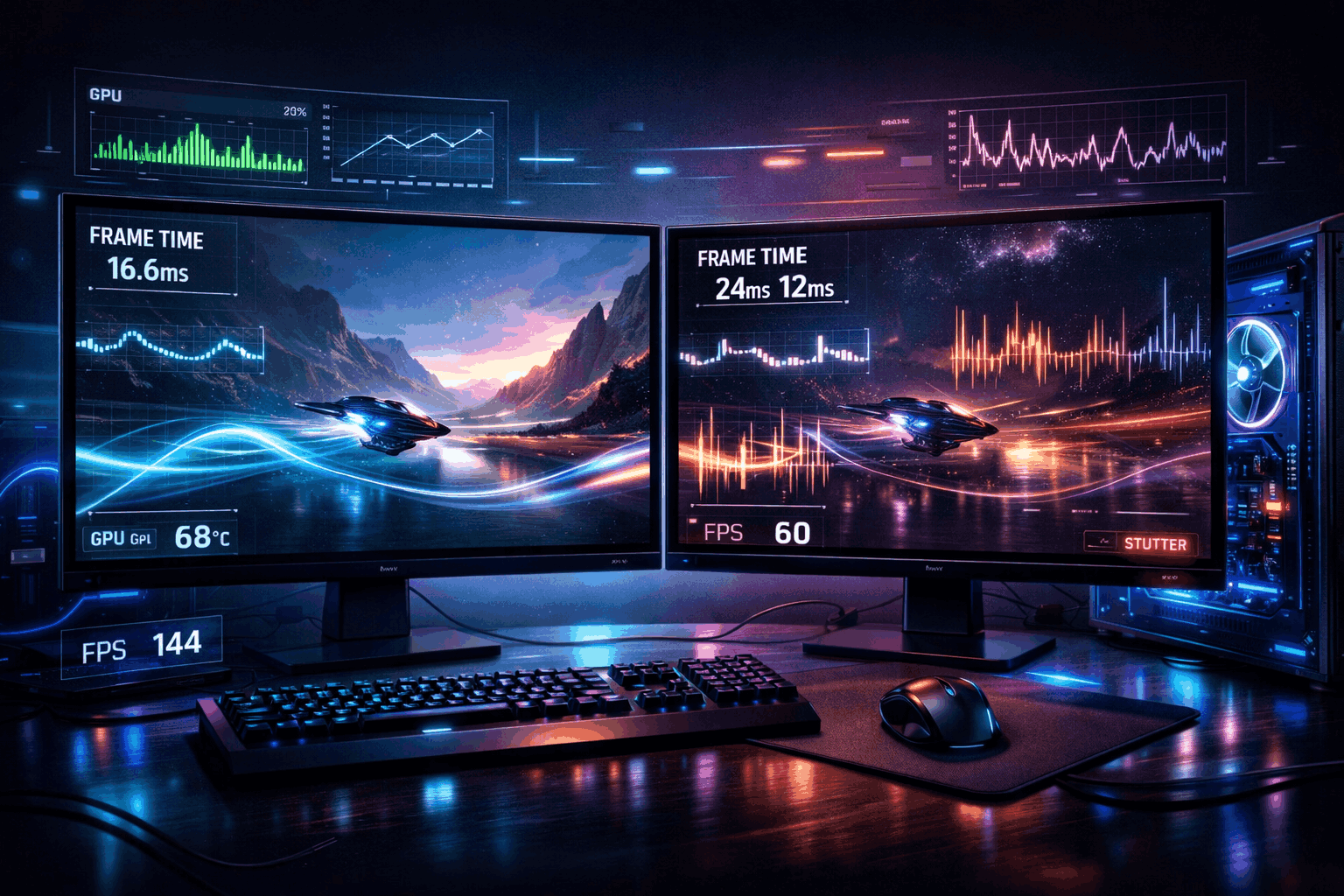
Frames per second represent a simple average. If a game renders sixty frames within one second, the reported frame rate is 60 FPS. However, this number reveals nothing about the distribution of those frames. They might arrive evenly every 16.6 milliseconds, or they might cluster unevenly, producing bursts followed by delays. To the player, these scenarios feel entirely different.
Frame timing measures the duration required to render each individual frame. When frames are produced at stable intervals, motion appears continuous and predictable. When timing fluctuates, visual flow becomes inconsistent. Even if the average frame rate remains unchanged, unstable frame delivery can introduce visible microstutters and perceptual discomfort. If you are curious about how game progression interacts with system performance, see Game Progression Systems.
Why Human Vision Exposes Irregularities
Human visual perception does not evaluate performance through averages. Instead, it responds to continuity and rhythm. The brain expects motion to follow stable temporal patterns, particularly during camera movement or fast action sequences. When frame intervals vary unexpectedly, the visual system detects discontinuities that manifest as stutter or uneven motion.
These irregularities often remain invisible to basic monitoring tools. A frame rate counter may display stable values, yet players still perceive instability. Frame pacing disruptions can create a sense of roughness that feels disconnected from reported performance metrics. This discrepancy frequently leads to confusion, especially when users attempt to diagnose performance issues using FPS alone.
Microstutter: The Silent Disruptor

Microstutter describes subtle yet perceptible inconsistencies in frame timing. Unlike dramatic frame drops, which are obvious and measurable, microstutters emerge from small variations that accumulate into noticeable instability. These fluctuations interrupt motion continuity, creating a sensation of unevenness even when average FPS appears acceptable.
Microstutter is deeply tied to frame time consistency because it originates from irregular frame intervals rather than insufficient frame counts. GPU scheduling, CPU workload spikes, memory access delays, and engine behavior can all contribute to timing disruptions.
Frame time consistency visualization illustrating stable performance and smooth gameplay experienceFor players, the experience is often frustrating. Controls may feel slightly delayed, camera movement appears irregular, and gameplay lacks the expected fluidity. Yet traditional metrics fail to capture the root cause, reinforcing the misconception that performance is solely about achieving higher FPS. For more insights on accessibility and smoother gameplay, see Video Game Accessibility.
Frame Pacing and Perceived Smoothness
Frame pacing refers to the uniformity of frame delivery. Even pacing means frames are spaced evenly, producing stable visual flow. Uneven pacing introduces visual jitter, disrupting the illusion of continuous motion. Frame pacing directly influences frame time consistency, making it a fundamental determinant of perceived smoothness.
Stable pacing ensures animation coherence, predictable input response, and consistent motion perception. Irregular pacing produces visual instability that feels disproportionate to reported frame rate. This explains why identical FPS values can generate vastly different user experiences.
Hardware Behavior and Timing Stability
Gaming hardware plays a significant role in frame delivery patterns. GPUs, CPUs, memory subsystems, and storage devices interact dynamically, influencing frame timing behavior. Performance bottlenecks are not always visible through utilization percentages alone. Timing irregularities frequently arise from synchronization conflicts and workload imbalances. For external technical reading, AMD provides useful resources on GPU and CPU interaction at AMD Gaming Technologies.
For example, a powerful GPU paired with a constrained CPU may generate uneven frame intervals despite maintaining high average FPS. Memory bandwidth limitations can trigger transient delays, while background processes may introduce scheduling disruptions. These factors collectively affect frame time consistency, shaping the real gameplay experience.
Frame Time Variance and Gameplay Feel
Frame time variance measures how much individual frame durations deviate from their expected intervals. Low variance indicates stability, while high variance signals irregularity. Players may not consciously analyze these fluctuations, yet their effects are immediately perceptible. Inconsistent frame delivery disrupts motion predictability, creating subtle discomfort that often escapes numerical diagnostics.
Frame time consistency becomes essential here because stable variance patterns directly correlate with perceived fluidity. When frames follow a predictable cadence, motion appears natural. When variance increases, even small deviations accumulate into visible instability. This phenomenon explains why certain gameplay sequences feel uneven despite seemingly adequate hardware performance. For more insights into internal game systems, check out Game Mechanics Explained.
Input Latency and Timing Irregularities
Smooth visuals are only part of the equation. Frame timing also influences input responsiveness. Rendering pipelines, buffering strategies, and synchronization mechanisms determine how quickly player actions appear on screen. Irregular frame intervals can amplify latency perception, making controls feel less immediate.
Stable frame time consistency reduces perceptual delay by maintaining predictable update cycles. This predictability enhances responsiveness, reinforcing the sense of control precision. Conversely, unstable timing introduces irregular feedback loops that subtly degrade interaction quality, particularly in fast-paced games where timing sensitivity is high. For external references, read NVIDIA’s guide on Gameworks Performance Tools.
GPU Queues, Scheduling, and Frame Stability
Modern GPUs rely on complex scheduling systems to process rendering workloads. Command queues, shader execution pipelines, and memory transactions interact continuously. Minor disruptions in scheduling can propagate through the pipeline, affecting frame timing behavior.
Frame time consistency reflects how effectively the GPU manages these operations. Stable queues produce predictable frame intervals, while contention or synchronization stalls generate variance. These effects may not drastically reduce FPS, yet they influence perceived smoothness.
This is why analyzing performance exclusively through frame rate often leads to incomplete conclusions. Stability metrics reveal the hidden dynamics shaping gameplay experience. For related reading, explore Video Game Accessibility and how system stability affects inclusivity in gameplay.
Game Engines and Timing Behavior
Game engines significantly influence frame delivery patterns. Resource streaming, physics updates, asset management, and rendering pipelines contribute to timing stability. Even well-optimized hardware can exhibit irregular frame behavior depending on engine workload distribution.
Frame time consistency therefore represents an interaction between software architecture and hardware execution. Engine design decisions, including threading strategies and memory allocation policies, shape frame pacing characteristics. Understanding this relationship clarifies why different titles behave differently on identical systems. For external insights, read Unity’s documentation on performance optimization.
Visual Smoothness vs Measured Performance
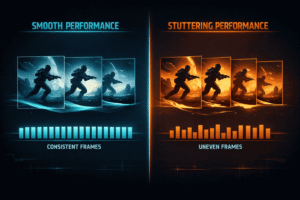
Players often encounter paradoxical scenarios: high frame rates paired with perceptible stutter, or moderate frame rates delivering surprising fluidity. These outcomes highlight the limitations of average-based metrics. Visual smoothness emerges from stable frame delivery rather than peak numerical values.
Frame time consistency provides the missing context, revealing whether frames arrive evenly or irregularly. Stable intervals create continuous motion perception, while variance disrupts visual coherence. This distinction transforms performance evaluation from superficial measurement to experiential analysis.
Optimizing for Stability Instead of Peaks
Performance optimization strategies frequently prioritize maximizing FPS. While higher frame rates offer benefits, stability often yields greater perceptual improvements. Reducing variance, eliminating spikes, and improving scheduling coherence can dramatically enhance gameplay feel without increasing raw frame counts.
Frame time consistency thus becomes a practical optimization target. Balanced workloads, minimized background interference, and synchronization tuning contribute more to perceived smoothness than isolated peak performance gains. For practical hardware tips, refer to AMD Gaming Technologies.
The Psychological Dimension of Smoothness
Human perception integrates visual rhythm, responsiveness, and motion continuity into a unified experience. Irregular frame delivery subtly increases cognitive load, as the brain compensates for unpredictable motion patterns. Stable frame time consistency reduces this strain, producing a sensation of effortless fluidity.
This psychological dimension explains why stable experiences feel “better” even when numerical metrics appear similar. Consistency aligns with perceptual expectations, reinforcing immersion and comfort.
Reframing Performance Discussions
Gaming performance is often reduced to simple comparisons, yet true experience quality depends on deeper factors. Frame time consistency reshapes performance evaluation by emphasizing stability over averages. It encourages more accurate diagnostics, better optimization priorities, and a richer understanding of gameplay feel.
As hardware and engines evolve, this metric becomes increasingly relevant. Smoothness is not merely about speed but about rhythm, predictability, and continuity — qualities that define the real interactive experience.
Ultimately, frame time consistency represents the invisible architecture of smooth gameplay. It is not always visible, rarely discussed, yet profoundly influential. Recognizing its importance allows players to interpret performance more intelligently and appreciate the subtle mechanics that shape truly fluid gaming experiences. For further reading on system balance and progression, visit Game Progression Systems.