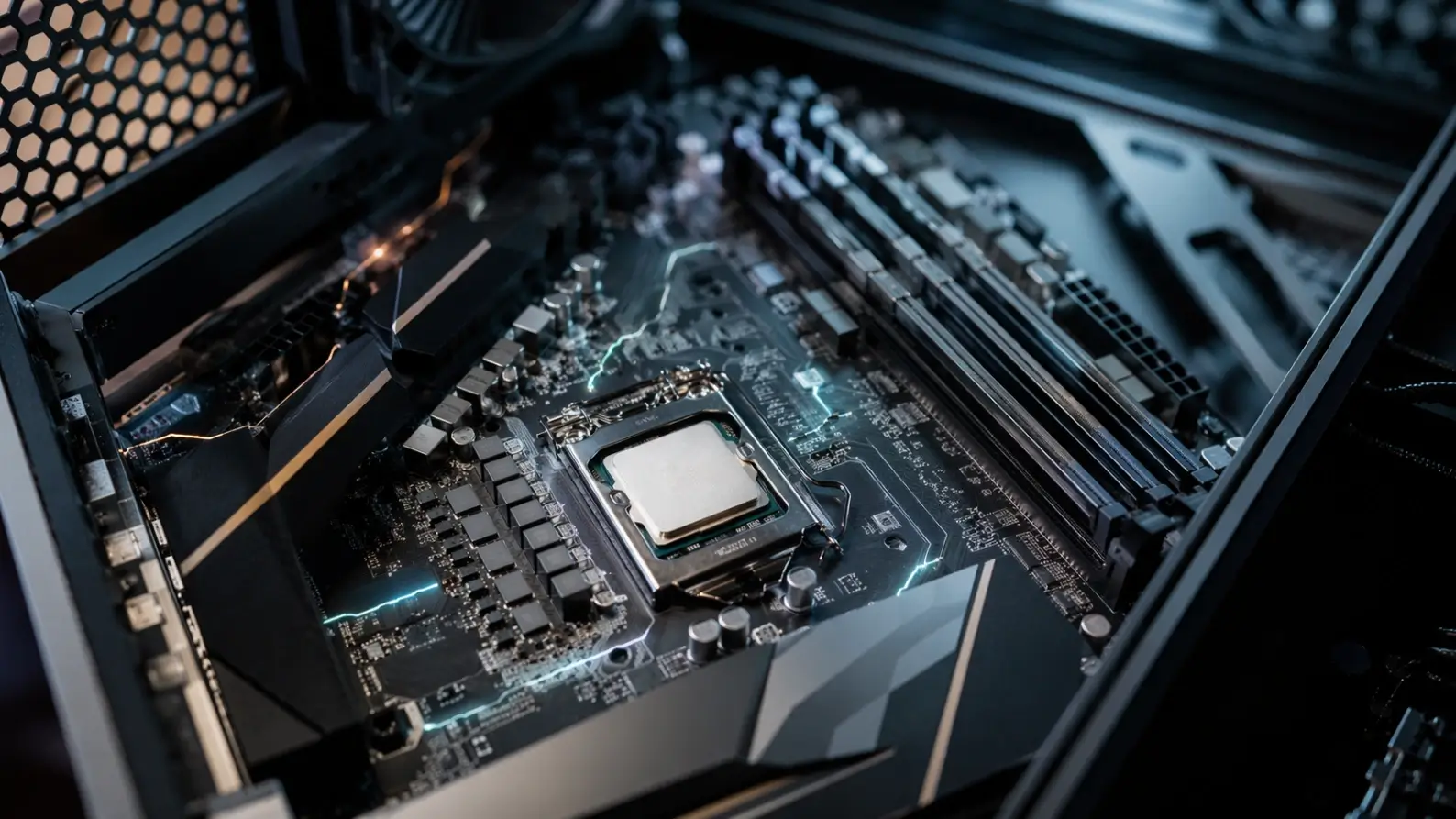
Digital Noise in Gaming Hardware: The Silent Threat Secretly Destroying Performance Stability
There’s a moment every PC gamer experiences but rarely understands. The frame rate looks stable, the hardware is powerful, temperatures are under control—and yet something feels off. The gameplay isn’t as smooth as it should be. Movements feel slightly inconsistent, and occasional micro-stutters appear without any obvious cause.
Most players immediately blame drivers, game optimization, or even background applications. But there’s a deeper, rarely discussed factor that quietly influences performance at a fundamental level: Digital Noise in Gaming Hardware.
This isn’t a software bug or a visible bottleneck. It’s an electrical phenomenon happening inside your system—one that can subtly interfere with signal integrity, timing precision, and ultimately the consistency of your gaming experience.
Understanding Digital Noise in Gaming Hardware doesn’t just explain those mysterious inconsistencies. It opens a new perspective on what “stable performance” actually means beyond FPS numbers.
What Digital Noise Really Means Inside a Gaming PC
At its core, digital noise refers to unwanted electrical interference that disrupts clean signal transmission between components. Every modern gaming system operates using high-speed electrical signals moving across incredibly dense circuits. These signals are expected to be precise, synchronized, and predictable.
But in reality, no electrical environment is perfectly clean.
Inside your motherboard, GPU, and power delivery systems, countless microscopic fluctuations occur. These fluctuations can slightly distort signals, introduce timing irregularities, or create tiny inconsistencies in how data is transmitted and processed.
This is where Digital Noise in Gaming Hardware becomes relevant—not as a catastrophic failure, but as a subtle destabilizing force.
It doesn’t crash your system. It doesn’t drop your FPS dramatically. Instead, it introduces small imperfections that accumulate over time, affecting how “smooth” and “consistent” your gameplay feels.
Why You Never See It in Benchmarks
Traditional benchmarks are designed to measure performance in averages: average FPS, maximum throughput, or peak efficiency. These metrics are useful, but they completely ignore micro-level inconsistencies.
This is why two systems with identical hardware and similar benchmark scores can feel different in real gameplay.
One might feel perfectly fluid, while the other feels slightly unstable—even if both report the same numbers.
The missing variable is often Digital Noise in Gaming Hardware.
Because this type of interference affects timing precision rather than raw performance, it manifests as:
- Micro-stutter without FPS drops
- Inconsistent frame delivery
- Slight input-response irregularities
If you’ve already explored topics like Frame Time Consistency, you know that smoothness depends on more than just frame rate. What many don’t realize is that electrical instability at the hardware level can quietly influence that consistency.
The Hidden Sources of Electrical Interference
To understand Digital Noise in Gaming Hardware, you need to look at where it originates. Unlike software issues, these sources are deeply embedded in the physical design of your system.
1. Power Delivery Fluctuations
Your CPU and GPU rely on extremely stable voltage to operate correctly. However, power delivery is never perfectly flat. Voltage regulators constantly adjust output to match demand, creating tiny fluctuations in the process.
Even high-quality systems experience this. The difference is how well those fluctuations are filtered and stabilized.
This connects closely with concepts discussed in Power Delivery Stability, but here we’re focusing on the electrical “noise layer” beneath that stability.
2. Signal Crosstalk on Dense Circuits
Modern motherboards and GPUs are incredibly dense. High-speed data lines run parallel to each other, often separated by microscopic distances.
When signals travel at such high frequencies, they can interfere with adjacent lines. This phenomenon, known as crosstalk, is a major contributor to Digital Noise in Gaming Hardware.
The result isn’t data loss—but slight distortion or timing shifts that ripple through the system.
3. Electromagnetic Interference (EMI)
Every electronic component emits electromagnetic fields. In a tightly packed gaming PC, these fields can interact in complex ways.
High-power components like GPUs and VRMs are especially active sources of EMI. Without proper shielding and design, this interference can subtly affect nearby circuits.
4. Grounding and PCB Design Limitations
Even the physical layout of a motherboard plays a role. Imperfect grounding, inefficient trace routing, or cost-cutting in PCB layers can increase susceptibility to electrical noise.
This is why not all hardware of the same category performs equally—even if specifications look identical on paper.
How Digital Noise Translates Into Real Gaming Behavior
At this point, it’s easy to assume that Digital Noise in Gaming Hardware is purely theoretical. But its effects become surprisingly tangible when you look at how games behave in real-time.
Modern games rely on precise synchronization between multiple subsystems:
- CPU processing game logic
- GPU rendering frames
- Memory transferring data
- Storage streaming assets
All of this happens in tightly coordinated cycles measured in milliseconds.
When electrical noise introduces even tiny timing inconsistencies, those cycles can become slightly misaligned. Not enough to cause failure—but enough to break perfect fluidity.
This is one of the hidden reasons behind:
- Random frame pacing irregularities
- Unexplained stutter in open-world scenes
- Inconsistent responsiveness during intense gameplay moments
It’s not that your hardware is “weak.” It’s that the underlying signal environment isn’t perfectly stable.
Why High-End Systems Still Experience It
A common misconception is that Digital Noise in Gaming Hardware only affects low-end or poorly built systems. In reality, high-end systems can be even more sensitive to it.
Why?
Because higher performance means:
- Higher frequencies
- Faster data transfer rates
- Tighter timing requirements
At these levels, even tiny electrical inconsistencies become more noticeable. What would be irrelevant at lower speeds can start to affect synchronization at high performance levels.
This is why some enthusiasts notice subtle instability even on top-tier builds—especially when pushing hardware to its limits.
The Illusion of “Perfect Stability”
Modern monitoring tools give us a sense of control. We track temperatures, clock speeds, usage percentages, and frame rates. When all these numbers look good, we assume the system is performing perfectly.
But Digital Noise in Gaming Hardware exists below the level of these tools.
It doesn’t show up in overlays. It doesn’t trigger warnings. It simply affects the quality of execution in ways that are difficult to measure but easy to feel.
This creates a gap between what the system reports and what the player experiences.
And that gap is where many “mysterious” performance issues live.
External Reference
For a deeper technical understanding of signal integrity and electrical noise in high-speed systems, you can explore this detailed explanation from Intel Signal Integrity Documentation.
In the next part, we’ll go deeper into how modern hardware tries to fight Digital Noise in Gaming Hardware, what design techniques actually matter, and how subtle differences in components can dramatically change real-world gaming consistency.
How Modern Hardware Designs Try to Suppress Digital Noise
Once you start looking beneath the surface, it becomes clear that Digital Noise in Gaming Hardware isn’t an accident—it’s a constant challenge that engineers actively fight against. Every high-performance component in your system is designed with one goal in mind: keep signals clean enough to maintain precise timing under extreme workloads.
But the way this is achieved is far more complex than most people realize.
Advanced VRM Filtering and Power Conditioning
Voltage Regulation Modules (VRMs) don’t just supply power—they refine it. High-end motherboards and GPUs use multi-phase VRM designs to smooth out voltage delivery and reduce ripple.
Each phase acts like a layer of correction, minimizing fluctuations before they reach sensitive components. The cleaner the power, the lower the contribution to Digital Noise in Gaming Hardware.
This is why premium boards often deliver more stable real-world performance—not because they increase raw power, but because they reduce electrical instability.
PCB Layering and Signal Isolation
Modern PCBs (Printed Circuit Boards) are built using multiple layers, each carefully designed to separate power delivery, ground planes, and high-speed data lines.
This separation reduces interference between signals and improves overall integrity. Higher-end GPUs and motherboards often feature more PCB layers specifically to combat Digital Noise in Gaming Hardware.
It’s an invisible upgrade—but one that directly impacts stability under load.
Shielding and Component Placement
Engineers also use physical design strategies to minimize interference. Sensitive components are positioned away from high-noise areas, and shielding is applied where necessary.
This is especially important in compact systems, where space limitations increase the likelihood of electromagnetic interference.
Even small placement decisions can influence how much Digital Noise in Gaming Hardware affects the system.
The Overlooked Role of the Power Supply Unit (PSU)
Most gamers choose a PSU based on wattage and brand reputation. But what often goes unnoticed is how much the quality of a PSU influences electrical cleanliness.
A poorly filtered PSU can introduce ripple and noise directly into the system, amplifying Digital Noise in Gaming Hardware across every component.
On the other hand, a high-quality PSU with strong filtering and stable rails acts as the first line of defense.
This doesn’t show up in FPS benchmarks—but it absolutely affects consistency.
Cables, Connections, and Signal Integrity
It might sound surprising, but even cables can play a role in Digital Noise in Gaming Hardware.
Poorly shielded cables, loose connections, or low-quality connectors can introduce interference or degrade signal quality. This is particularly relevant for:
- PCIe power connectors
- Display cables (especially at high refresh rates)
- Internal motherboard connections
At high data rates, even minor signal degradation can translate into subtle inconsistencies.
Again, not enough to cause failure—but enough to affect smoothness.
Why Some Systems “Feel” Better Than Others
This brings us to an interesting observation: two systems with similar specifications can feel completely different during gameplay.
One might deliver a perfectly fluid experience, while the other feels slightly uneven—even though benchmarks say they’re identical.
One of the hidden reasons is how well each system manages Digital Noise in Gaming Hardware.
Factors that contribute to this difference include:
- Motherboard quality and PCB design
- GPU build quality
- PSU filtering capability
- Overall electrical environment inside the case
This is also why consistency-related topics, like GPU Memory Bandwidth, don’t tell the full story on their own. Performance isn’t just about speed—it’s about how cleanly that speed is delivered.
Environmental Factors You Don’t Think About
Interestingly, Digital Noise in Gaming Hardware isn’t limited to what’s inside your PC. External conditions can also play a role.
For example:
- Unstable wall power
- Electrical interference from nearby devices
- Poor grounding in the building
While modern PSUs are designed to handle imperfect input, extreme conditions can still introduce additional noise into the system.
This is rare—but when it happens, it can be incredibly difficult to diagnose.
Why Overclocking Can Amplify the Problem
Overclocking pushes hardware beyond its default operating conditions. Higher frequencies and tighter timings leave less room for error.
This means that any existing Digital Noise in Gaming Hardware becomes more impactful.
What was previously negligible can now cause:
- Micro-instability
- Frame pacing inconsistencies
- Subtle responsiveness issues
This is why a system that passes stress tests can still feel slightly unstable in real gameplay.
Stress tests focus on extremes. Games expose timing sensitivity.
The Difference Between Measurable Performance and Perceived Smoothness
One of the most important takeaways is that measurable performance doesn’t always match perceived smoothness.
You can have:
- High FPS
- Low temperatures
- Stable clock speeds
And still experience inconsistency.
Digital Noise in Gaming Hardware exists in that gap—between what tools can measure and what players actually feel.
It’s part of the reason why achieving truly “perfect” smoothness is so difficult, even with high-end hardware.
A More Realistic View of Gaming Performance
After understanding Digital Noise in Gaming Hardware, it becomes clear that performance isn’t just about eliminating bottlenecks or increasing raw power.
It’s about achieving balance:
- Clean power delivery
- Strong signal integrity
- Well-designed components
- Stable system environment
When all of these align, the result isn’t just higher performance—it’s better consistency, smoother gameplay, and a more responsive experience.
And that’s something no benchmark alone can fully capture.
Personal Perspective
From my own experience working with different gaming PC setups over time, I’ve come to realize that performance consistency isn’t always about raw power. I’ve tested systems that look nearly identical on paper—same GPU class, similar CPU performance—yet one feels noticeably smoother during real gameplay. At first, it’s easy to blame drivers or game optimization, but after digging deeper, it becomes clear that there are underlying factors most people never consider.
What stands out to me is how subtle hardware-level behavior can influence the overall experience. Things like power quality, motherboard design, and signal integrity don’t show up in benchmarks, but you can feel their impact. This is exactly why Digital Noise in Gaming Hardware is such an interesting concept—it explains those small inconsistencies that don’t have an obvious cause.
Personally, I no longer look at performance as just numbers on a screen. A system that feels stable, predictable, and consistent is far more valuable than one that simply delivers higher peak FPS. That shift in perspective completely changes how I evaluate gaming hardware today.
External Reference
For additional insight into power integrity and electrical noise behavior, this technical overview from Texas Instruments provides a deeper perspective: Understanding Power Supply Noise.
Final Thoughts
Most performance discussions focus on visible metrics—FPS, utilization, temperatures. But beneath all of that, there’s a hidden layer that quietly shapes the entire experience.
Digital Noise in Gaming Hardware is part of that layer.
It doesn’t dominate performance. It doesn’t define your system’s capabilities. But it influences the quality of execution in ways that are subtle, cumulative, and surprisingly important.
Once you understand it, you start seeing gaming performance differently—not just as numbers on a screen, but as a complex interaction of physics, engineering, and precision timing working together behind the scenes.