Game Asset Streaming: The Technology That Powers Massive Open Worlds Without Loading Screens
Modern video games have reached a level of scale and complexity that would have been impossible just a decade ago. Players can now explore enormous cities, dense forests, and vast landscapes without ever encountering a loading screen. Behind this seamless experience lies a powerful technology known as Game Asset Streaming.
This technology has become a fundamental part of modern game engines, enabling developers to create massive environments while maintaining performance and immersion. Instead of loading an entire game world at once, Game Asset Streaming allows the game to load only the assets required for the player’s current location and actions. This intelligent data management system ensures smooth gameplay while preventing hardware overload.
Many modern open-world titles rely heavily on Game Asset Streaming to deliver large environments filled with detailed objects, characters, textures, and environmental effects. Without this technology, even the most powerful gaming systems would struggle to run these worlds efficiently.
For example, games like
Red Dead Redemption 2
and
The Witcher 3
demonstrate how advanced streaming systems can deliver expansive environments that feel alive and continuous.
The Evolution of Game World Loading
Before modern streaming systems were introduced, video games relied on a much simpler loading structure. Entire levels were loaded into memory before gameplay could begin. This approach worked well when game worlds were relatively small, but it became a serious limitation as developers began building larger environments.
Older games often forced players to wait through long loading screens between areas. These transitions broke immersion and limited how expansive game worlds could be. As gaming hardware evolved and players demanded richer environments, developers needed a more advanced solution.
That solution eventually became Game Asset Streaming. Instead of loading entire levels at once, games could dynamically load assets as the player moved through the world. This allowed developers to design environments that were dramatically larger without overwhelming system memory.
What Game Asset Streaming Actually Does
At its core, Game Asset Streaming is a system that continuously loads and unloads game data while the player explores the environment. Game assets include textures, 3D models, animations, sound files, terrain data, and environmental effects.
Rather than loading all of these assets at once, the streaming system carefully decides which data should be present in memory at any given moment. As the player approaches a new location, the engine begins loading nearby assets in the background. Meanwhile, assets from areas the player has already left are gradually removed from memory.
This constant balancing process allows games to present incredibly detailed environments without exceeding hardware limits. The result is a seamless experience where players can travel across large landscapes without interruptions.
The Role of Game Engines
Modern game engines play a crucial role in implementing Game Asset Streaming. Engines such as
Unreal Engine
and
Unity
provide developers with sophisticated systems that manage asset streaming automatically.
These engines track player movement, camera direction, and environment visibility in order to determine which assets should be loaded next. Advanced algorithms predict the player’s movement and begin streaming required data before the player even reaches a new area.
This predictive behavior is essential for maintaining smooth gameplay. Without it, players would encounter noticeable delays whenever new environments appear on screen.
Texture Streaming and Visual Detail
One of the most important components of Game Asset Streaming is texture streaming. Textures are the image files that give surfaces their visual appearance, such as brick walls, grass fields, metal surfaces, and character clothing.
High-resolution textures require significant memory resources. If every texture in a large open world were loaded simultaneously, the game would quickly exceed system memory limits. Texture streaming solves this problem by loading different texture resolutions depending on the player’s distance from objects.
Objects that are far away may use lower-resolution textures, while objects close to the player load high-resolution versions. This system ensures visual quality without unnecessary memory usage.
Level Streaming and World Segmentation
Another key component of Game Asset Streaming is level streaming. Instead of treating the entire world as a single environment, developers divide the world into smaller segments or zones. Each zone can be loaded or unloaded independently depending on player location.
When a player approaches a new area, the game engine quietly loads that segment while the player is still exploring the previous one. By the time the player crosses into the new zone, the required assets are already prepared.
This system allows developers to design incredibly large environments without requiring excessive memory usage.
Hardware That Supports Streaming Technology
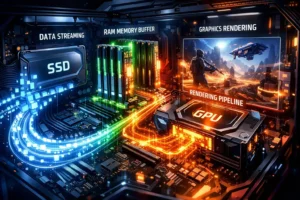
Hardware advancements have also played a major role in the success of Game Asset Streaming. Modern solid-state drives (SSDs) dramatically improve how quickly games can load data. Faster storage allows engines to stream assets more efficiently while minimizing delays.
Memory capacity and bandwidth are also critical factors. Larger memory pools allow games to hold more assets simultaneously, while high memory bandwidth ensures that assets can be transferred quickly between storage and system memory.
According to technical documentation from
Microsoft Game Development, modern streaming systems rely heavily on high-speed storage pipelines to maintain stable performance in large game environments.
The Invisible Technology Behind Immersion
When implemented effectively, Game Asset Streaming becomes completely invisible to the player. The world simply feels continuous, responsive, and alive. Mountains appear naturally in the distance, cities expand as the player approaches, and dense environments remain rich with detail.
This seamless experience is the result of constant background data management that players rarely notice. Streaming systems work continuously throughout gameplay, carefully balancing performance, memory usage, and visual fidelity.
As game worlds continue to grow larger and more detailed, Game Asset Streaming will remain one of the most important technologies powering modern interactive experiences.
In the next section of this article, we will explore advanced streaming techniques used by modern game engines, including predictive streaming systems, memory optimization strategies, and the future of large-scale game world technology.
Predictive Streaming Systems in Modern Games
As modern games became more complex, developers realized that traditional loading strategies were no longer sufficient. This led to the development of predictive systems that enhance Game Asset Streaming. Instead of waiting for the player to approach a new location, predictive systems analyze player behavior and movement patterns to anticipate which assets will be needed next.
When a player moves through a game world, the engine constantly monitors several factors such as player speed, camera direction, and navigation paths. Using this data, the engine predicts where the player is likely to go and begins loading the required data in advance. This predictive approach ensures that environments appear instantly when players reach new locations.
The accuracy of these predictions is extremely important. If the engine loads too many assets unnecessarily, memory usage increases. If it loads assets too late, players may experience visible pop-in effects or momentary delays. Efficient Game Asset Streaming systems carefully balance these factors to maintain stable performance.
Memory Optimization Strategies
Memory management is one of the biggest challenges in large-scale game development. Modern environments contain thousands of objects, textures, sound effects, and animations that must be managed efficiently. Advanced Game Asset Streaming systems rely on sophisticated memory optimization techniques to prevent performance issues.
One common strategy involves prioritizing assets based on importance and visibility. Objects that are directly in front of the player receive the highest priority, while distant objects receive lower priority. This ensures that the most important elements are always available while less critical data can be streamed gradually.
Another key technique is asset compression. Many modern engines compress textures and models before loading them into memory. Once the data reaches the system, it can be decompressed quickly by the GPU. This reduces storage bandwidth usage and allows Game Asset Streaming to handle much larger environments.
Developers also rely on memory pooling systems that reserve blocks of memory specifically for streaming operations. These pools allow engines to quickly allocate and release memory as the player moves through the world.
Streaming and Environmental Complexity
As environments become more detailed, the importance of Game Asset Streaming continues to grow. Large cities, dense forests, and complex terrain systems require enormous amounts of visual data. Without efficient streaming technology, these environments would quickly overwhelm system memory.
Environmental systems such as dynamic weather, day-night cycles, and physics interactions also increase the complexity of modern games. Each of these systems introduces additional assets that must be loaded and updated in real time.
To manage this complexity, game engines organize world data into structured hierarchies. Terrain layers, environmental objects, vegetation systems, and lighting data are often streamed independently. This layered approach allows Game Asset Streaming to deliver detailed environments without overloading hardware resources.
The Role of SSD Technology
Storage technology has dramatically improved the effectiveness of Game Asset Streaming. Traditional mechanical hard drives were limited by slow read speeds, making it difficult for engines to stream large amounts of data quickly.
Modern solid-state drives provide significantly higher data transfer speeds. This allows engines to retrieve textures, models, and environment data almost instantly. Faster storage reduces loading delays and helps maintain smooth performance even in complex environments.
Game developers now design their streaming systems with high-speed storage in mind. Technical documentation from
NVIDIA Developer
explains how faster storage pipelines enable more aggressive streaming strategies in modern game engines.
Reducing Visual Pop-In
One of the biggest visual challenges associated with streaming technology is the appearance of objects suddenly popping into view. This issue occurs when assets are not loaded early enough. Advanced Game Asset Streaming techniques aim to minimize this problem through careful data prioritization.
Level-of-detail systems are often combined with streaming pipelines to reduce visual artifacts. Instead of instantly loading a high-resolution model, the engine may first load a simplified version of the object. As the player approaches, more detailed versions gradually replace it.
This gradual transition ensures that visual changes remain subtle and natural. When implemented correctly, players rarely notice that the streaming system is constantly replacing and updating assets in the background.
Streaming in Massive Open Worlds
Large open-world games represent the most demanding use case for Game Asset Streaming. These environments may contain hundreds of square kilometers filled with detailed terrain, complex cities, wildlife systems, and interactive objects.
To support worlds of this scale, developers divide environments into streaming regions. Each region contains its own set of assets that can be loaded independently. As the player travels across the map, the engine continuously streams new regions while removing older ones from memory.
This approach allows developers to design environments that feel vast and continuous without overwhelming system resources. Some of the most impressive modern game worlds rely heavily on this form of Game Asset Streaming.
The Future of Streaming Technology
Looking forward, streaming technology will continue to evolve as game worlds grow even larger and more detailed. Developers are exploring new methods for improving Game Asset Streaming, including machine learning systems that can predict player movement more accurately.
Cloud-based storage and distributed data pipelines may also influence future streaming architectures. These technologies could allow developers to store massive asset libraries while delivering only the data required for each gameplay moment.
Another emerging trend involves procedural content systems that generate environments dynamically. When combined with Game Asset Streaming, procedural generation could allow virtually unlimited game worlds to exist without requiring massive storage resources.
Why Streaming Technology Matters for the Future of Gaming
As interactive entertainment continues to evolve, the scale of digital environments will only increase. Players expect seamless worlds filled with detail, activity, and environmental complexity. Meeting these expectations requires sophisticated data management systems.
Efficient Game Asset Streaming allows developers to deliver immersive worlds while maintaining stable performance across a wide range of hardware configurations. Without this technology, many of the most ambitious modern games simply would not be possible.
From open landscapes to dense urban environments, streaming systems operate silently behind the scenes, ensuring that each new location appears exactly when it should. This invisible technology plays a critical role in shaping the future of modern game design.
As hardware capabilities expand and engine technologies advance, Game Asset Streaming will remain a core component of how interactive worlds are built and experienced.
To learn more, take a look at Gaming Technology