
Video Game Accessibility: The Powerful Impact of Inclusive Design on Better Gaming
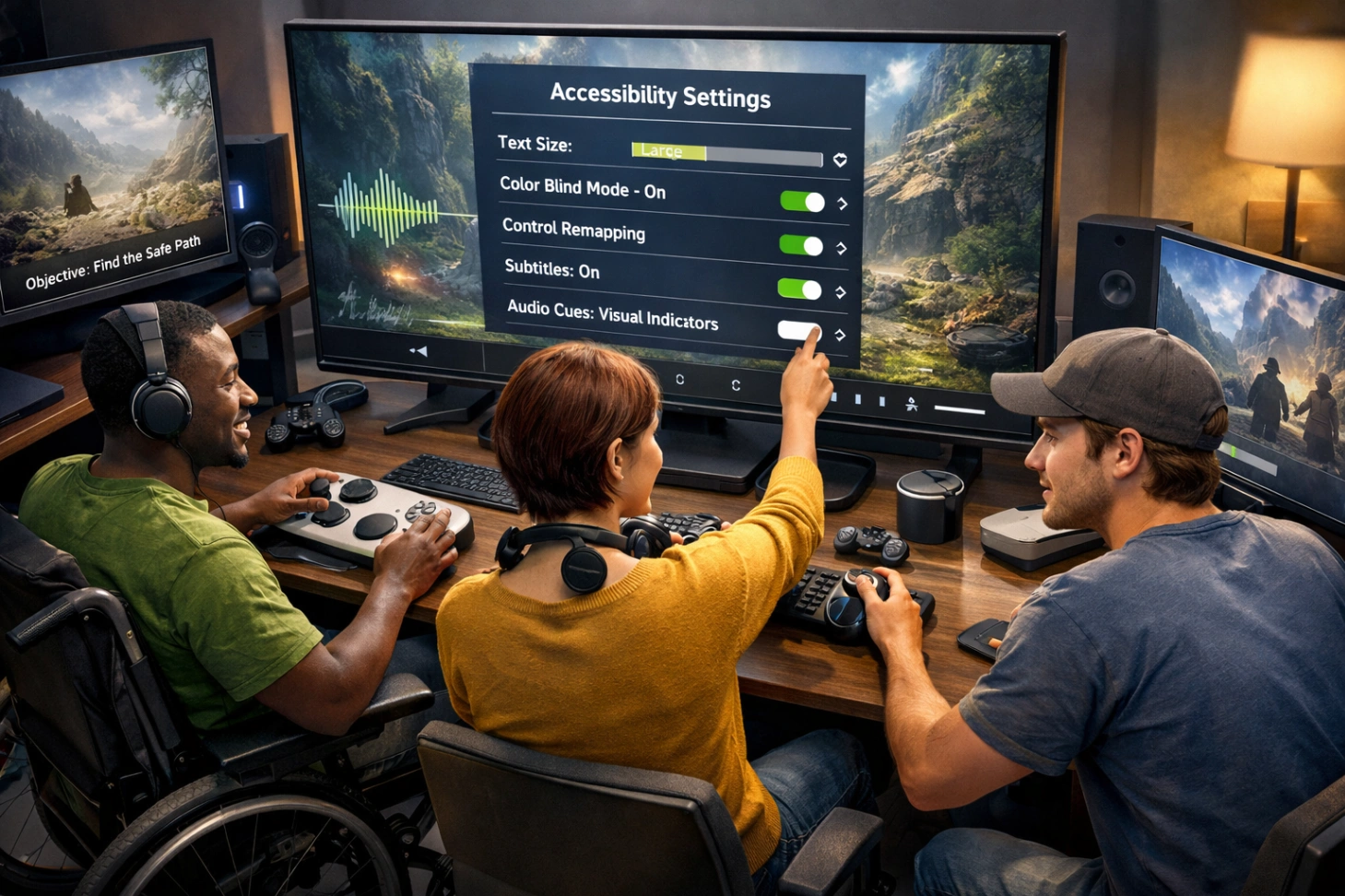
Video game accessibility has become one of the most important topics in modern gaming, yet it is still widely misunderstood. At its core, video game accessibility refers to the design choices and features that allow players with different abilities, preferences, and limitations to enjoy games without unnecessary barriers.
For many years, games were created with a narrow definition of the “average player.” Today, that mindset is changing. Developers, publishers, and players are recognizing that accessibility is not about lowering difficulty or simplifying gameplay, but about giving players options. When games are accessible, more people can experience stories, mechanics, and worlds that would otherwise be out of reach.
What Does Video Game Accessibility Really Mean?
Video game accessibility is often confused with difficulty settings, but the two are not the same. Accessibility focuses on removing obstacles that prevent players from interacting with a game, while difficulty determines how challenging the gameplay is once access is possible.
Examples of accessibility barriers include unreadable text, color-based puzzles that exclude colorblind players, control schemes that require precise motor skills, or audio-only cues that lock out deaf players. Accessibility features aim to address these issues through thoughtful design.
Common accessibility categories include visual, auditory, motor, and cognitive accessibility. A well-designed game does not need to cover every possible scenario, but it should offer flexible systems that adapt to different needs without compromising the core experience.
Why Accessibility Matters in Modern Games
The gaming audience is far more diverse than it was a decade ago. Players come from different age groups, cultures, and physical conditions. Some players may have permanent disabilities, while others experience temporary limitations due to injury, fatigue, or environment.
From a design perspective, video game accessibility improves usability for everyone. Larger text benefits players on small screens. Customizable controls help both players with disabilities and competitive players seeking optimal setups. Clear visual cues enhance understanding, not just accessibility.
This evolution mirrors trends already seen in other areas of gaming, such as the growing focus on single-player experiences, where pacing and player control are central to immersion.
Visual Accessibility Features in Games
Visual accessibility is one of the most visible aspects of inclusive game design. These features help players who have low vision, color blindness, or sensitivity to visual effects.
Common visual accessibility options include adjustable text size, high-contrast interfaces, customizable HUD elements, and colorblind modes. The best implementations allow players to fine-tune these settings rather than relying on presets.
Games that support visual accessibility often provide alternatives to color-based information. For example, shapes, patterns, or icons can replace color cues, ensuring that important gameplay information is never locked behind visual assumptions.
Audio Accessibility and Inclusive Sound Design
Audio plays a critical role in games, but it can also create exclusion. Players who are deaf or hard of hearing may miss essential information if audio cues are not supported by visual alternatives.
Subtitles are the most common solution, but quality matters. Good subtitles include speaker identification, sound effect descriptions, and adjustable text size. Poor subtitles, on the other hand, can create more confusion than clarity.
Visual indicators for sound-based events, such as directional arrows or screen effects, are another important part of audio accessibility. These features ensure that gameplay information is communicated through multiple channels.
Control Customization and Motor Accessibility
Motor accessibility focuses on how players interact physically with a game. Traditional control schemes assume fast reflexes and precise input, which can be limiting for many players.
Key remapping, controller sensitivity adjustments, toggle options instead of button holds, and support for alternative input devices all contribute to better accessibility. These features allow players to adapt the game to their physical comfort rather than forcing adaptation in the opposite direction.
This design philosophy aligns closely with trends seen in indie games, where flexibility and player-first design often take priority over rigid conventions.
Cognitive Accessibility and Clear Game Design
Cognitive accessibility is one of the least discussed but most impactful areas of video game accessibility. It includes features that help players understand, process, and remember game information.
Clear tutorials, optional hints, adjustable game speed, and simplified interfaces can make games more approachable without reducing depth. Importantly, these features should be optional, allowing players to choose the level of assistance they need.
Games that respect cognitive accessibility tend to feel more welcoming overall. They communicate goals clearly, avoid unnecessary complexity, and trust players to engage at their own pace.
Accessibility Is Not a Genre Limitation
A common myth is that accessibility only applies to certain types of games. In reality, video game accessibility can be implemented across all genres, from action and strategy to role-playing and narrative-driven experiences.
Even competitive and challenging games can include accessibility options without compromising their identity. Accessibility does not remove challenge; it removes unfair barriers that prevent players from engaging with that challenge in the first place.
As games continue to evolve as interactive media, accessibility is becoming a standard expectation rather than a bonus feature. Players are increasingly aware of these options and value developers who take inclusive design seriously.
How Accessibility Improves Game Quality for Everyone
One of the most overlooked truths about video game accessibility is that its benefits extend far beyond players with disabilities. When developers design games with flexibility and clarity in mind, the overall quality of the experience improves for all players.
Clear interfaces reduce confusion, customizable settings increase comfort, and alternative feedback systems improve responsiveness. These improvements do not dilute creativity; instead, they refine it. Games become easier to understand, more intuitive to control, and more respectful of the player’s time and attention.
In many cases, accessibility-driven design results in fewer frustrations, smoother onboarding, and stronger long-term engagement. This directly contributes to healthier player communities and better retention.
The Business Case for Inclusive Game Design
Beyond ethics and usability, accessibility also makes sense from a business perspective. The gaming audience includes millions of players who benefit from accessible features, whether due to permanent disabilities, temporary conditions, or situational limitations.
When a game supports inclusive design, it naturally reaches a wider audience. This does not require massive budgets or radical redesigns. Often, accessibility features are incremental improvements that deliver long-term value.
Publishers have also discovered that accessible games receive more positive reviews, stronger word-of-mouth, and longer lifespans. As digital storefronts become more competitive, quality-of-life features can be a deciding factor for players choosing between similar titles.
Accessibility and Player Choice
At its heart, accessibility is about choice. Players should be able to decide how they experience a game, rather than being forced into a single rigid design philosophy.
Options such as adjustable difficulty pacing, interface scaling, control remapping, and optional assistance systems empower players to tailor the experience to their needs. Importantly, these options should never be hidden or treated as secondary features.
When accessibility settings are presented clearly and respectfully, players feel welcomed instead of singled out. This approach reinforces the idea that accessibility is a standard part of modern game design, not a niche accommodation.
Common Mistakes in Accessibility Implementation
Despite good intentions, accessibility features are sometimes implemented poorly. One common mistake is offering surface-level options without meaningful customization. For example, a single colorblind mode may not work for all types of color vision differences.
Another issue is locking accessibility options behind gameplay progression. Players should be able to configure accessibility settings before starting the game, not after encountering barriers.
Finally, accessibility should be integrated into the core design process rather than added at the final stage. When inclusive thinking begins early, features feel natural instead of forced.
Learning from Industry Standards
The gaming industry does not operate in isolation. Other digital industries have established accessibility standards that can inform game development practices.
Guidelines such as those provided by the World Wide Web Consortium (W3C) emphasize clarity, flexibility, and user control. While games are interactive in unique ways, the underlying principles remain relevant.
Similarly, organizations like Game Accessibility Guidelines offer practical, experience-based recommendations tailored specifically to video games. These resources help developers move beyond theory and into actionable design.
Accessibility and the Evolution of Game Design
As games continue to mature as a medium, accessibility is becoming a natural part of design conversations. It is no longer treated as an optional feature or a marketing checkbox.
This evolution mirrors shifts seen in other areas of gaming, such as the move toward fairer game monetization models that respect players instead of exploiting them. In both cases, trust and long-term engagement are prioritized over short-term gains.
Developers who embrace inclusive design tend to experiment more thoughtfully, communicate more clearly, and listen more closely to their communities. These habits lead to better games overall.
How Players Can Advocate for Better Accessibility
Players play an important role in shaping the future of video game accessibility. Constructive feedback, thoughtful reviews, and respectful discussions all contribute to positive change.
Supporting games that prioritize accessibility sends a clear message to developers and publishers. Visibility matters, especially in a crowded market where attention is limited.
Players can also share accessibility knowledge within their communities, helping others discover features they may not realize exist. Awareness is often the first step toward inclusion.
The Future of Accessible Gaming
Looking ahead, accessibility is likely to become even more deeply integrated into game engines, development tools, and platform standards. As technology evolves, new opportunities for inclusive interaction will emerge.
However, technology alone is not enough. True progress depends on mindset. When developers view accessibility as a creative challenge rather than a limitation, innovation follows naturally.
The future of gaming is not about designing for a single type of player. It is about recognizing diversity as a strength and building experiences that invite everyone to participate.
Conclusion: Accessibility as a Core Design Value
Video game accessibility is not a trend, a feature, or a compromise. It is a reflection of thoughtful, player-centered design. Games that embrace accessibility respect their audience, value inclusion, and deliver stronger experiences as a result.
As players and creators continue to push the medium forward, accessibility will remain a defining factor in what makes games truly great. Not because it simplifies them, but because it makes them playable, understandable, and enjoyable for more people.
In the end, accessible games are not just better for some players. They are better games.